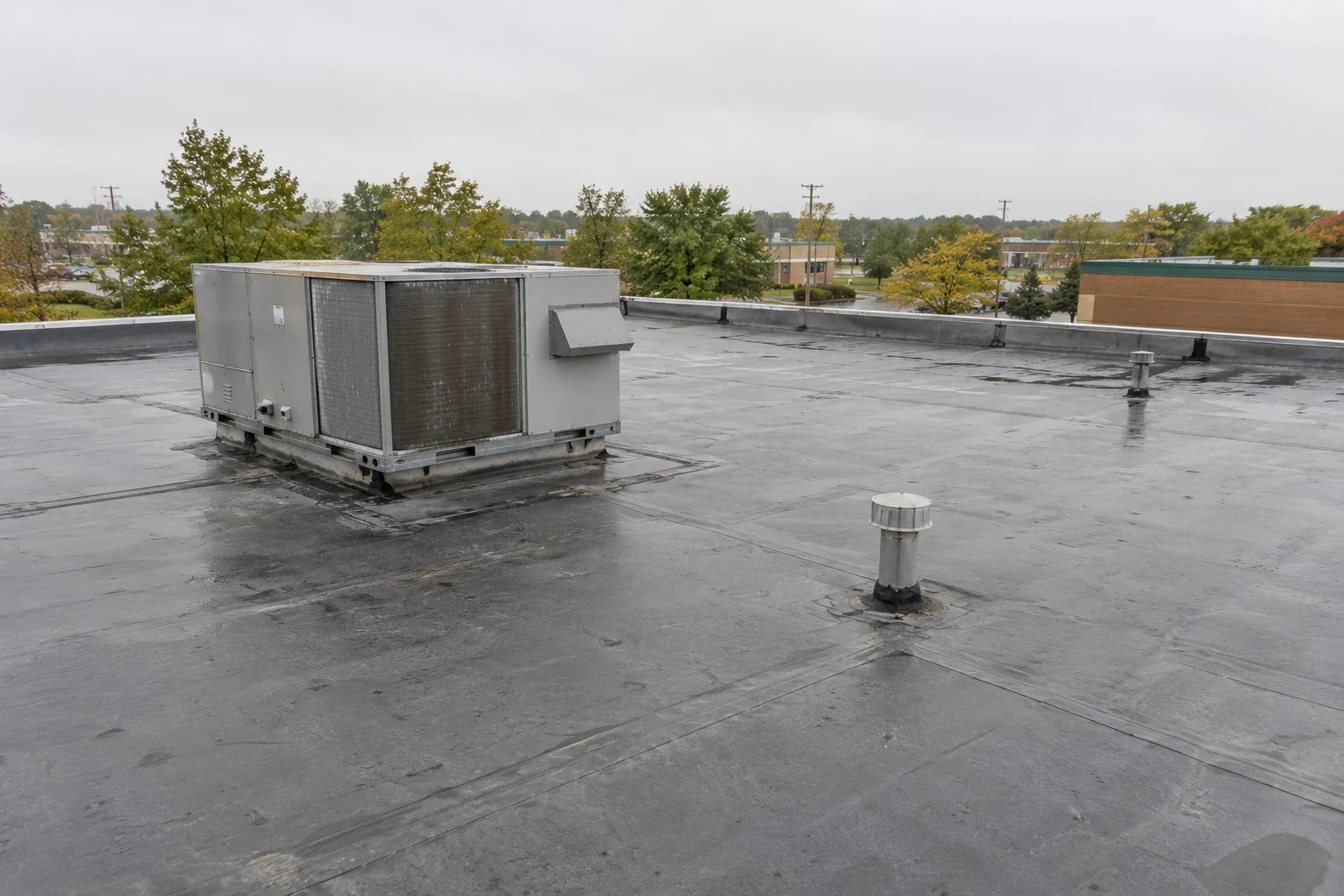
A school roof section that holds water after a thaw is a problem that gets worse in July, when the building is empty and the money is finally available. Springfield, MA schools sit across the city, from the elementary schools in East Springfield to the four public schools in Pine Point and the seven in Sixteen Acres. A count of schools is not a count of roofs, and each building has its own wings, additions and roof sections, usually from different decades. We start with the section that holds water or drips into a classroom, because the access route, the weather window and the permit review all hinge on what that section turns out to be.
Snow and ice work on each roof section differently
Heavy snow and ice on roofs is one of the damages named when Massachusetts hazard planning ranks severe winter storms, and school roofs carry that load too. On a school, that load does not fall evenly. Drifts build against a taller gym wall, behind a mechanical screen and at a roof step between an old wing and a newer one.
We walk those transitions first. We look for compressed insulation, cracked flashing at the step, ponded areas where a drift melted slowly and ice dams at the eave. A section that deflects under foot or shows fresh cracking at the deck line goes to the engineer before anyone discusses membrane. Where the structure is sound, the repair follows the water path and not the classroom plan.
Summer is the weather window, and it is short
Most districts want major work done between June and the start of classes. That window is real, but it is short, and permit review, material lead times and a wet week can all consume it. We ask for the district's calendar early and work back from the first day of school to set the latest date for a start.
Plans for alterations and repairs go to Springfield's Building Division, which holds the work to the state code and local zoning. That code is currently the tenth edition of 780 CMR, and commercial energy rules carry state amendments. If a reroof adds insulation or alters the assembly, it passes through that review, and the review time goes into our schedule. The turnover date is the one that matters, not the start date.
Tornado history is part of the conversation as well. On June 1, 2011, an EF3 tornado crossed Springfield, and the Weather Service survey recorded roofs taken off some big commercial brick buildings. For schools, that means edge securement and parapet condition deserve a close look, since wind lifts a roof at the perimeter before it fails in the field.
Drain paths set the life of a flat school roof
Low-slope school roofs live or die by their drains. A strainer clogged with leaves, a drain body set above the surrounding deck or an overflow scupper that was capped during an earlier project will each turn a rainstorm into a ponding problem. Water standing for days works on seams and on the insulation beneath.
We trace the drain and scupper path from each low point to its outlet, test flow and check the interior leaders where the district can give us access. If a low area keeps water after the drain is clear, the fix may be tapered insulation, a new outlet or a corrected curb. We price each, so the district can see what is repair and what is correction.
Keep students and staff away from the work zone
Even in summer, schools host programs, custodial crews and sports camps. The work zone has to be fenced, signed and separated from any route used by people on site. Roof access, hoisting and debris chutes are drawn on a site plan before mobilization, and the plan identifies parking, bus lanes and drop-off points that must stay open.
Inside, the concern is dust and noise near spaces in use, such as offices, kitchens and rooms with equipment. For a school that stays in session during part of the work, an occupied building reroofing plan sets quiet hours, protects ceilings and closes each roof section before crews leave. A named contact on the district's side lets us adjust the same day.
Survey before the capital request is written
A capital request built on a stain pattern is a weak request. We prefer a commercial roof inspection that records every section, its membrane, its drainage and its repairs, with moisture mapping on the sections that leak. That survey turns into a ranked list the district's facilities staff can defend.
The list feeds a roof capital plan: which sections to repair this year, which to replace and which to watch. Districts that manage many buildings can use it to sequence work across East Springfield, Pine Point and other neighborhoods, instead of chasing whichever roof leaked last.
Pick the system after the survey
School roofs commonly use single-ply membranes or modified bitumen, and each has trade-offs. An EPDM roof is forgiving at details and easy to repair. A TPO roof reflects heat and welds at the seams. A modified bitumen roof offers redundancy in layers. The survey, the deck and the district's maintenance habits decide among them.
Whatever the membrane, the tie-in matters most where old meets new, and the same attention applies to a municipal building sharing a campus. Phased projects leave temporary tie-ins through winter, so we design them to shed water and survive freeze and thaw. Gym and cafeteria roofs, which sit higher than the classroom wings, need their own tie-ins, and the college and university practice of staging by building wing works at the K-12 scale too. The turnover record shows where each tie-in sits and what it is made of, which saves the next contractor an afternoon of probing.
Warranty paperwork follows the same logic. Many districts hold several warranties from different years, each with its own inspection and notice terms. We list them by roof section in the roof warranty management file, so a repair on one section does not accidentally void coverage on another.
Close out with a turnover record
At the end of each section we photograph the finished work, record the product and note any concealed conditions found. At the end of the project the district receives a roof plan with section numbers, the warranty documents, the drain locations and a list of conditions that need follow-up. That record is also what a successor facilities manager will need. If a section was left for a later phase, the record says why, what condition it was in and when to look at it again. A district that keeps this record can answer a board member's question about any roof in minutes.
Commercial Roofing Questions
How early should a district start planning a summer reroof?
Start the survey in fall or winter. That leaves time for design, permit review, bidding and material orders before June. A project started in spring often loses weeks to lead times.
Can a leaking classroom roof wait until summer?
A temporary repair can hold in many cases. We seal the entry point, protect the ceiling and record the cause. The permanent work then goes into the summer schedule with real data behind it.
What does a flat school roof need before the first snow?
Clear drains, tight flashings and secure edge metal. Cleared drains matter because melt water has to leave the roof. We also check roof steps, where drifts build.
Do older wings and newer additions need separate plans?
Yes. They usually have different decks, insulation and ages. Each section gets its own findings, repairs and cost. The tie-in between them gets special care.
Who receives the turnover record?
The district's facilities lead gets the full set. It includes photographs, product data, warranty papers and drain locations. We can also send a short summary to the principal.