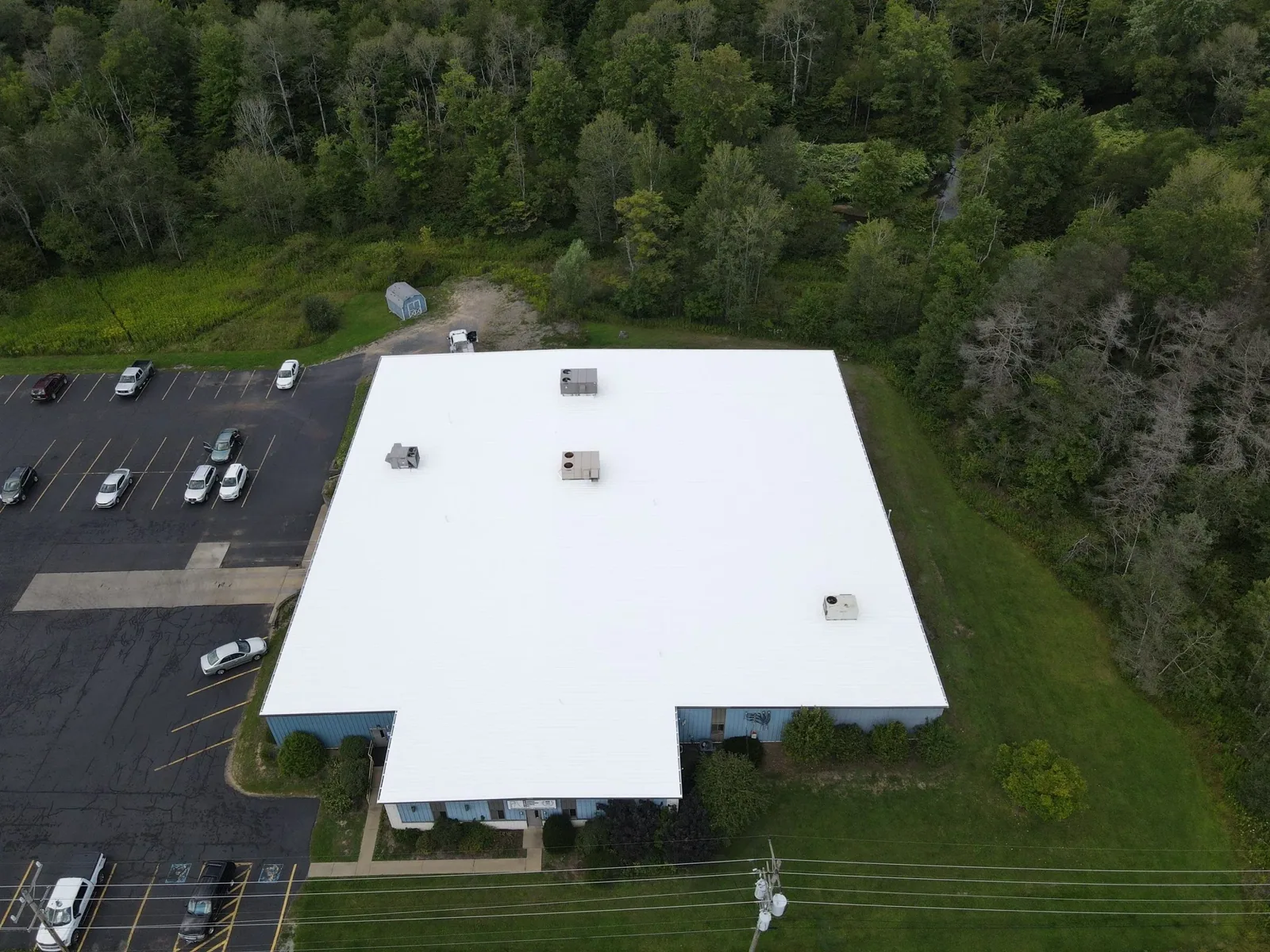
A TPO roof that looks clean from the hatch can still be failing at the corners, where heat-welded seams meet flashing and the sheet has to change direction. We start there. On a Springfield, MA commercial building, the first walk covers the seam probe, the flashing laps, the drains and the insulation joints, because those decide whether the next step is a repair, a recover or a new membrane. TPO is a white single-ply sheet welded with hot air, so its weak points are the welds and the details, not the field. Our commercial roof repair work begins with a marked roof plan and a photo of each open seam. Before we give a number, the owner or the general contractor has the plan in hand and can see which areas are sound, which are suspect and which are open.
Probe the seams
A good weld shows a continuous bead at the edge and resists a probe. We run a blunt tool along the lap and mark any spot where the edge lifts, where the weld skipped or where a patch sits over a cut. Corners and T-joints get extra time, since three layers meet there and the heat has to reach all of them. We also test whether a prior repair used a compatible patch, since a TPO patch that was only glued, or a different membrane material, will lift at the edge and look like a new leak.
Seam trouble tells us more than a single leak does. One open lap near a drain suggests a local fix. Open laps in several areas, or a sheet that has shrunk away from a curb, point to a membrane near the end of its working life. We record both patterns on the roof plan so the repair boundary is visible before anyone prices it.
Flashing deserves the same discipline. Walls, curbs and pipe penetrations need a flashing sheet that is welded, not just caulked, and a termination bar that holds the top edge tight. Where we find sealant doing the work of a weld, we mark it as a temporary condition. That sealant will crack with the first hard freeze, and the leak call arrives in March instead of being fixed in the fall.
Know how the sheet is held down
TPO can be mechanically attached with fasteners and plates, fully adhered, or ballasted. Each fails differently. A fastened sheet can flutter under suction and loosen plates; an adhered sheet can lose bond at the edges; a ballasted roof hides its condition under stone. We find out which system is on the roof, how many layers sit below it and whether the insulation is dry. A small test cut at a low corner usually answers all three, and we close it with a temporary patch the same day.
That matters because a June 2011 tornado rated EF3 by the National Weather Service tore roofs off some large commercial brick buildings in Springfield. Edge securement and perimeter fastening are not decoration here. When we replace or recover, we detail the corners and perimeter first and check that the specification fits the 780 CMR 10th Edition and the energy provisions Massachusetts adds to IECC 2021.
Plan for snow, ice and thaw
Massachusetts treats heavy snow and ice as a roof hazard: its 2023 resilience plan names damaged roofs among the effects of severe winter storms and ranks them a high-likelihood hazard. For a TPO roof, the consequence is simple: water that cannot reach a drain freezes, expands and works at the seams. We trace each drain path, clear strainers and check for low spots where ice forms. If a drain bowl is cracked or sits proud of the membrane, it is on the repair list, not the maintenance list, because it will pond water and freeze.
Thaw cycles also move flashing at walls and curbs, and ice dams at a parapet can push meltwater behind the termination. A membrane that was tight in July can be pulling at a termination bar in February. We check terminations, sealant and counterflashing while the roof is cold and the movement is visible. For industrial buildings in the Wason/North Industrial Park area, we trace drain runs the same way, starting at the lowest outlets.
Choose repair, recover or replacement
If the insulation is dry and the sheet has life left, local repair and re-welded laps can carry the roof another cycle. If the insulation is dry but the membrane is spent, a roof recover overlay can add a new sheet without full tear-off, provided the structure and code allow it. If the insulation is wet in several areas, we remove it and the sheet together. Cover board matters in that decision. A new TPO sheet laid over soft or uneven insulation will telegraph every flaw, so we price a cover board and a tapered layer where the drain path needs help, and we show the owner the cost of each layer on its own line.
An infrared moisture survey draws that line before pricing. Compared with PVC roofing, TPO usually costs less per square foot and welds with similar equipment, while PVC tolerates grease and chemicals better. A rubber alternative such as EPDM roofing joins seams with tape or adhesive instead of heat, which changes the repair method and the weather window.
Close out with records
The turnover record lists the membrane thickness and manufacturer product line as installed, the fastening pattern, the seam test results, the repair limits and the photos of each opening. It also names the next inspection trigger: after the first heavy freeze, after a wind event or at the end of the warranty period. If the owner holds a manufacturer warranty, we keep the notice letters and approved repair steps in the same file, so a later claim is not delayed by missing paper.
For owners in the Metro Center business and government district, that record tells the next contractor what lies under the top sheet. The same file lists drain locations, curb heights and the paths crews take to reach rooftop units, since boots wear a TPO sheet faster than weather does and a walkway pad costs far less than a patch.
Commercial Roofing Questions
Can TPO seams be repaired without replacing the roof?
Yes, when the sheet is clean, flexible and the insulation below is dry. We clean the lap, re-weld or patch it, and probe the surrounding seams to confirm the limit of the repair.
How long does a TPO repair visit take?
A targeted seam or flashing repair is often a short visit once access is set, and weather matters because heat welding needs a dry sheet and wind that does not cool the weld too quickly. A section with wet insulation takes longer because it needs removal, drying and a new tie-in before the crew leaves.
What makes TPO fail early?
Poor welds at corners and details, ponding water, fasteners backing out and chemical exposure near exhausts. We look at each during the first walk.
Does TPO work for a recover?
It can, over a dry and sound existing roof with a suitable cover board. The base must hold fasteners or adhesive, and code limits on layers apply.
What should I have ready for a TPO inspection?
Any roof plan, warranty paper and repair history, plus the leak locations, the date of the last repair and the best access times for the roof hatch or lift. If none exist, we build the record on the first walk.