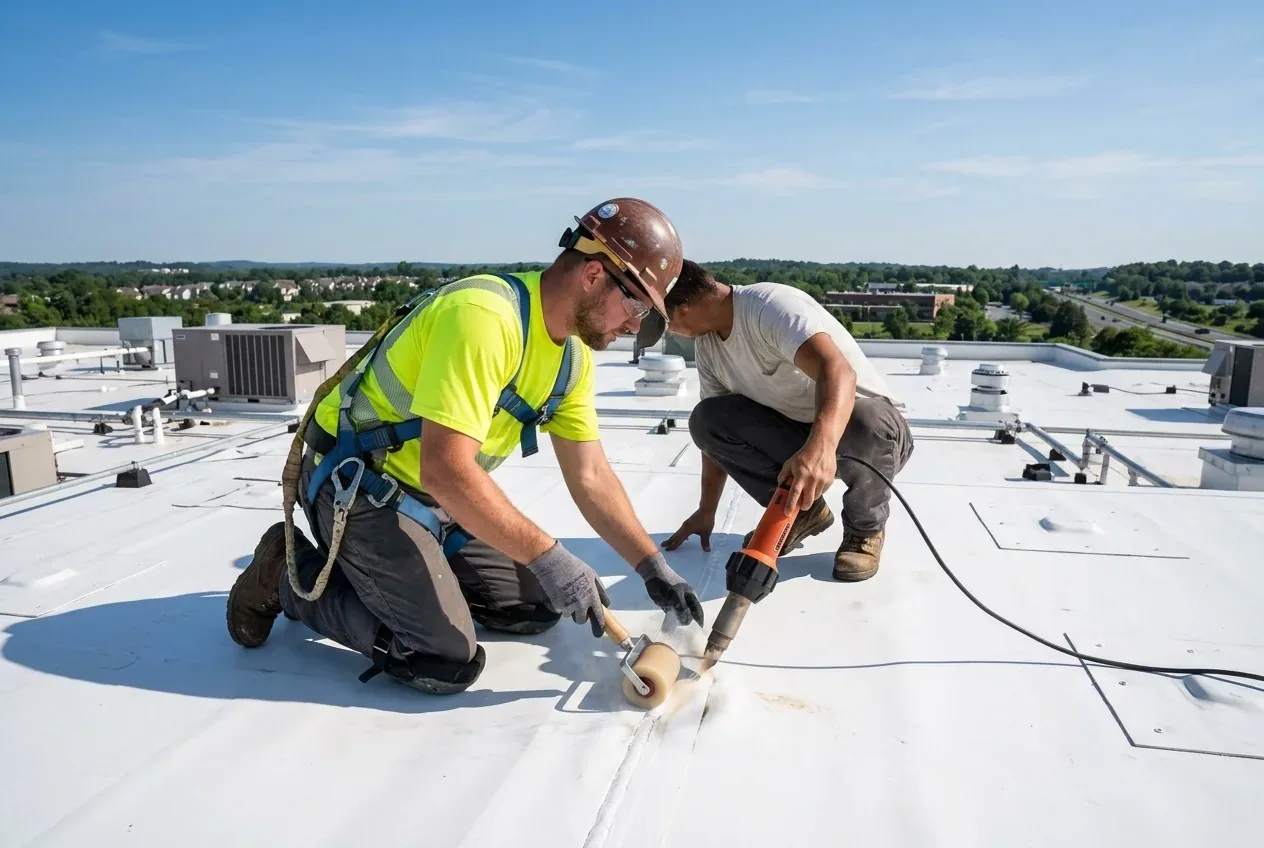
A KEE roof can look identical to a standard PVC roof until you read the sheet label or test a sample, and the difference decides which repair material is allowed. KEE, short for ketone ethylene ester, is a PVC-alloy membrane built for roofs that take oils, fats, solvents and fumes, and the additive in the sheet resists the plasticizer loss that makes plain PVC go brittle. On Springfield, MA industrial and process buildings, we confirm the membrane before we cut, weld or patch anything. A mismatched patch can fail at the edge within a season, and a failed patch next to exhaust is hard to diagnose later. The first job is to identify the sheet, the seams and the exposure. We then give the owner or the contractor in charge of the work a single sheet that says what the roof is, where it is damaged and what the repair will and will not cover, so decisions are made before the lift arrives.
Identify the membrane and its history
We start with records: the original specification, warranty paper, repair invoices and any sample left in the building. If none exist, we take a small coupon from a hidden spot and compare thickness, reinforcement and weld behavior. We also look at the field for signs of an earlier recoating or a spliced section of a different material.
Thickness and reinforcement matter too. A scrim-reinforced sheet behaves differently from an unreinforced flashing sheet, and a repair that ignores the difference can leave a stiff patch beside a flexible field, which concentrates movement at the edge of the patch. We record the sheet details so the next repair uses the same family of material.
The point is practical. A KEE sheet welds with hot air to compatible KEE or PVC material, but not to every membrane on the market. If the roof has been patched with a non-compatible sheet or a coating, the weld boundary moves and the repair grows. We mark what is original, what is patched and what is unknown on the plan, so the owner and the general contractor see the same picture.
Map what the roof is exposed to
Process exhaust can carry oils, solvents, cooking fats or chemical vapors, and where it lands depends on fan placement and wind. We map every discharge point, mark staining on the sheet and check whether the membrane near each is soft, tacky, swollen or discolored. We also look at walk pads, sealants and pitch pans, which often fail before the sheet does. Once the map is complete, we compare it with the building's current process: if a vent has been added or moved, the map changes, and so does the maintenance plan.
Two settings show why. Along the Roosevelt Avenue corridor, the city has an industrial site that fronts the avenue and is visible from I-291. In the Chicopee West End, the city's plan identifies older industrial mill properties. Industrial buildings can change use over time, and a roof that once served a dry warehouse may now sit under a process line. We check the equipment, not the label on the building.
Set the repair boundary at the exposure line
Where the sheet is sound and dry, repairs are local welds, flashing replacements and boot swaps. Where exhaust has softened the surface or the weld has lifted in several places near a discharge, the boundary widens to a section. We use an infrared moisture survey to see whether water has reached the insulation, because wet insulation under a chemical-exposed section is a removal item, not a coating item.
Time is part of the decision. A section with local damage can be repaired in a short visit, while a section that needs wet insulation removed needs a dry-in plan, staged material and a weather window. We price both and name the findings that would move the work from one to the other, such as a core that shows wet board or a seam probe that opens more laps than the survey showed.
Compared with plain PVC, KEE costs more and is chosen when exposure is real. For a roof with only light exposure, a PVC membrane may be enough, and where there is no chemical exposure at all, TPO roofing may be the lower-cost choice. A coating over an aged KEE sheet is rarely a good path, since adhesion and compatibility are uncertain; if an owner asks, we test a small area and show the result before pricing.
Detail for wind and winter
A tornado rated EF3 swept through Springfield on June 1, 2011 and, per the Weather Service survey, took roofs off some big commercial brick buildings; edge securement is therefore a first-order detail on any replacement. Massachusetts' resilience plan also counts roof damage from snow and ice load among winter-storm impacts. For a KEE roof, that means we look at perimeter attachment, drain capacity and the support under heavy equipment.
When we replace or recover, we specify cover board where the insulation needs a firm surface, and we check that the build-up meets the insulation and cover board requirements of the state's commercial energy code, the 2021 model code with Massachusetts amendments. The permit set shows the layers, the fastening and the flashing heights, so the city reviewer can approve it without a second round of questions.
Winter timing deserves a line of its own. Welding hot-air seams in cold, damp weather is difficult, so we plan critical seam work for suitable days and keep temporary protection in place on the others. A section sealed with a good temporary detail in January is better than a rushed permanent weld that fails in April.
Hand over a record that names the membrane
The turnover file states the membrane type, thickness, reinforcement, seam method and exposure map. It records the compatible repair materials and the cleaners to avoid. If the plant adds a vent or changes a process, the maintenance team can look at the file and see where the sheet needs protection. The file also holds the photographs of each weld probe, so a later inspector can compare like with like.
The same sequence applies on a manufacturing plant roof: find the exposure, name the material, set the limit and write it down.
Commercial Roofing Questions
How is KEE different from standard PVC?
KEE is a PVC alloy with a ketone ethylene ester additive that slows plasticizer loss and resists oils, fats and many chemicals. It is chosen for heavy exposure. We confirm which sheet is on the roof before any repair.
Can I patch KEE with PVC?
Sometimes, if the materials are compatible and the surface is clean. We make a test weld and probe it before committing. An unknown patch material is treated as unknown until tested.
What does exhaust damage look like?
Soft or tacky sheet, discoloration, swollen seams and sealant that has failed near a vent. We map the staining and test the membrane to find where the damage stops.
Does KEE need a coating?
Usually not. Coating over aged KEE carries adhesion risk, and a coating can hide the seam condition we need to see. We test a small area when an owner asks and report what we find, including the adhesion result and the cost of the alternative.
What records should I give you?
The spec, warranty, repair invoices and a list of equipment added since installation. If you have none, we build the record on the first walk.