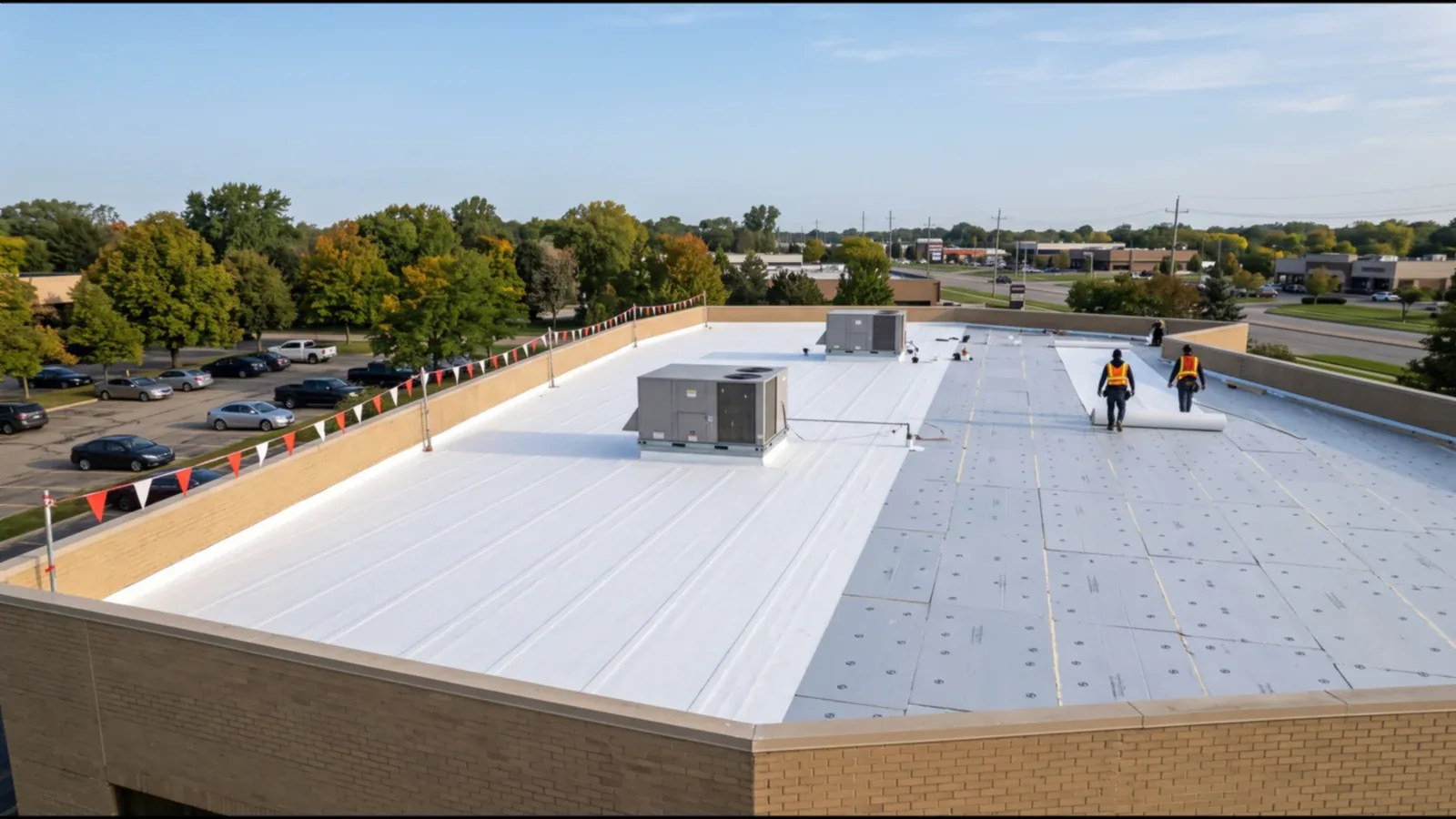
An EPDM sheet that pulls tight against a wall and bridges the corner can tear loose from the flashing in the next hard freeze, and the leak shows up weeks later in a room nowhere near the wall. We look for that first on Springfield, MA rubber roofs. EPDM is a black or white synthetic rubber membrane, joined with tape or adhesive instead of heat, and it stays flexible in cold weather, which is why it has a long history on northeastern flat roofs. Its weak points are the seams, the flashing and shrinkage at terminations. A careful walk before any repair tells us whether the roof has years left or whether the next dollar belongs in a recover. For the general contractor or facility lead who has to schedule around it, we deliver the findings on a marked drawing with a short punch list, so the roofing question can be answered before other trades are booked.
Read the seams and the splices
EPDM seams are made with splice tape or bonding adhesive, and they fail in a pattern: the edge lifts, dirt collects under it, and water follows the open channel. We press along every lap with a probe and look for gaps, fishmouths and wrinkles that point toward the seam. Where an earlier repair used a patch, we note whether it sits flat or has lifted at the corners.
Field seams on an older roof can be a separate problem from flashing seams. A roof with a sound field and open flashing laps is a detail repair. A roof with open field seams in several areas is telling us about adhesive or tape age. We mark both on the plan so the owner sees which kind of problem the roof has before a number is discussed.
Surface preparation decides whether a repair lasts. EPDM must be clean, dry and primed where the manufacturer's method calls for it. We avoid working in damp or cold conditions that stop adhesive from curing, and when the weather will not allow it, we install a temporary protection and return in a better window. A repair done in poor conditions looks fine on the day and fails by spring.
Check shrinkage and bridging at walls
EPDM can shrink over time, and a sheet that was installed with a little slack can become taut at curbs, parapets and pipe penetrations. Taut rubber bridges inside corners and tears under thermal movement or ice. We look at every vertical transition, feel for tension and check that the termination is still fastened and sealed along its length.
When shrinkage is the cause, a patch does not fix it. The sheet needs to be released, re-formed at the corner and re-terminated, or the area needs a new flashing strip. This is usually a modest repair if caught early. Waiting turns it into a section replacement, and the difference in cost is the reason we flag tension during the walk rather than at the next leak call. We also check pipe boots and pitch pans, which are common shrinkage points on older rubber roofs and are cheap to correct before they open. Small laps open for the same underlying reasons in a seam failure repair, and the shrinkage check carries over to it.
Move water off before the freeze
In the state's 2023 resilience analysis, severe winter storms rank high in likelihood, and snow and ice weight on roofs is one of the impacts it names. On an EPDM roof, ponding water adds load and freezes against seams. We trace water to each drain, check the drain bowl and clamping ring and note where water stays after a thaw.
If standing water recurs, the fix may be a new outlet, tapered insulation or a corrected sump, not another patch. Our roof drains and scuppers work is built on that sequence: confirm the path, repair the outlet, then judge whether slope correction belongs in the scope. In the Indian Orchard Business Park, a multi-property park that the Springfield Redevelopment Authority reported fully occupied in 2022, occupied buildings make timing as important as method. We agree on the work zone, the access route for the lift and the hours when noisy work can happen, then write them into the daily plan so tenants and neighbors know what to expect.
Repair, recover or replace the sheet
A sound, dry EPDM roof with isolated seam trouble is a repair. A dry roof with a worn sheet and no major defects can take a recover, often with a cover board and a new membrane. Wet insulation in several areas means removal in those areas. An leak investigation narrows the cause before we price anything.
Compared with modified bitumen roofing, EPDM is lighter and faster to install, but mod-bit offers more puncture resistance on roofs with heavy foot traffic. Compared with welded single-ply sheets, EPDM seams are more sensitive to surface prep. We lay out these tradeoffs on one sheet with first cost, repair frequency and access needs, so the decision comes from the building's use. A white single-ply such as TPO roofing is another candidate when reflectivity and heat-welded seams are priorities, and we explain what each choice changes in the detail work.
Leave a record the next crew can use
Every EPDM job ends with a turnover record: seam locations repaired, flashing replaced, sheet thickness and color, adhesive and tape type, and photos before and after. It lists the next inspection trigger, such as after the first freeze or after a major wind event. Where the sheet carries a manufacturer warranty, the file also holds the notice requirements and the approved repair methods, which keeps a later claim from stalling over missing paper.
Across the line in Chicopee, which has four industrial parks tracked by the Westover Metropolitan Development Corporation, an owner of several buildings can use a common record format to rank roofs by condition and spend where the risk is highest.
Commercial Roofing Questions
Why does an EPDM roof leak at a wall in winter?
Cold shrinks the sheet and ice loads the termination. A taut sheet can pull from the flashing or tear at the corner. We check tension and termination bars, then repair or re-form the corner.
Can EPDM seams be re-taped?
Yes, when the surface is clean and dry and the rubber is not degraded. We clean the lap, prime it and apply new tape or adhesive, then probe the seam after it sets. If the rubber is chalky or cracked, we cut back to sound material first.
Is EPDM a good choice after a tornado or high wind?
Wind resistance depends on attachment and edge securement more than on the sheet. Perimeter detail is the first check on every system, given the 2011 tornado that crossed the city. We specify fasteners and edges for the exposure, and we list the pattern in the closeout so a later inspector can compare it with what is on the roof.
How do I tell if a patch has failed?
Look for lifted corners, wrinkles and dirt under the edge. A failed patch often means the surface was not prepared or the material was not compatible. We replace it with a correct detail.
Can I add insulation under a new EPDM sheet?
Yes. We confirm the existing deck and insulation, add tapered board where drainage needs help and select a cover board suited to the sheet. We review the code edition and energy rules first, because the city's Building Division applies the state code to alterations and repairs.