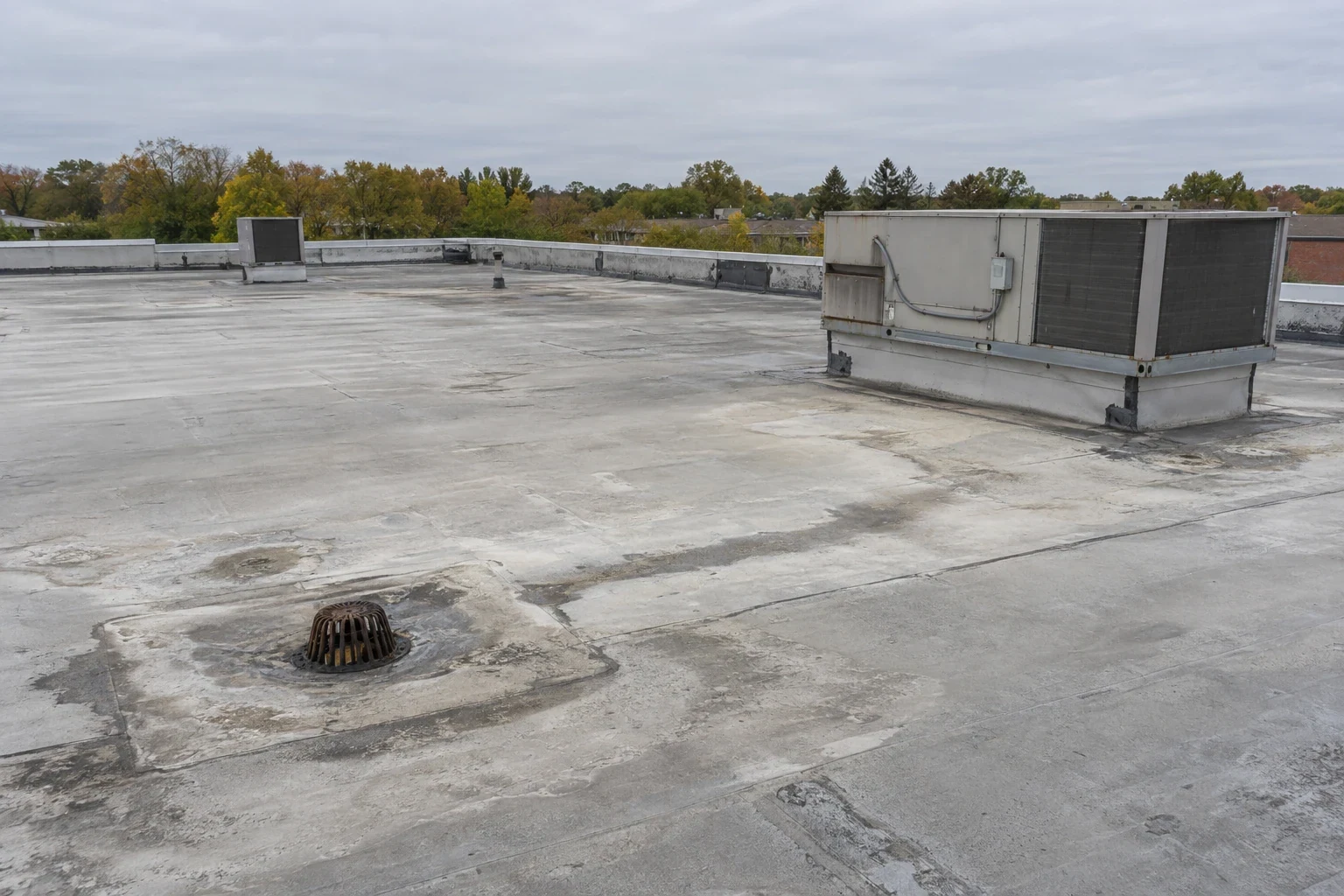
A roof capital request is easier to compare when the condition, work limits, and assumptions sit beside the budget year. We inspect the roof, separate urgent repairs from planned renewal, and identify what still needs testing before a cost is set. Springfield's winter exposure and its mix of medical, downtown, and industrial buildings make a single age-based schedule unreliable. A roof near the Medical District may have occupied-space constraints; a section in East Springfield may require different equipment access. Each budget line begins with the building and actual roof condition.
Set the current condition
We record the assembly where known, leak history, visible defects, drainage, edge details, prior repairs, and any moisture checks. Representative openings may be needed when the surface cannot show insulation or deck condition. The report separates what the crew observed from what remains concealed. That distinction affects the estimate: wet insulation, deteriorated deck, or an unknown number of roof layers should not be hidden inside a general allowance that makes bids hard to compare.
A commercial roof inspection creates a baseline for a repair or replacement decision. Some commercial buildings in Springfield lost roofs during the June 2011 tornado. A capital request should separate any documented repair from present-day renewal needs. We check the current perimeter, seams, and flashing, then carry only verified conditions into the budget year. Event history can prompt a review, and the roof as it stands today sets the scope.
For a complex assembly, an infrared moisture survey can guide test locations, while test cuts confirm concealed layers. We list the sample locations, results, and areas not tested so the budget carries the right uncertainty.
Compare practical scopes
Three choices often appear in a roof plan: repair a defined area, restore a sound assembly, or replace the section. We compare those choices using the same roof limits and known conditions. A recover may be possible when the existing layers are suitable, attachment and added load work, drainage remains adequate, and code requirements are met. Replacement may be more direct when moisture is widespread or the deck needs repair. The report states what supports each option instead of reducing the decision to a product name.
Massachusetts uses IECC 2021 with state amendments for its base commercial energy code. Insulation and roof assembly choices can affect compliance, so the design team should review the proposed layers under current code. We note the existing insulation, cover board, and penetrations where visible. A recover feasibility review can test an overlay against those conditions, while a replacement scope can define tear-off, deck review, and closeout assumptions. Each option is costed separately where the owner needs a fair comparison.
Map timing and exposure
Schedule follows access, weather windows, material lead time, permit review, and how much roof can be closed safely each day. In an occupied building, we may phase the work around deliveries, tenants, or active rooms. On a roof with several additions, tie-ins and drainage changes can drive the sequence more than total area. A phased reroof plan can identify work zones, daily closure, and the access route that remains open.
In winter, snow and ice add weight to roofs and the structures beneath them. In Springfield, that makes drainage and edge conditions useful checks after a weather event. A capital schedule can set an inspection trigger and keep emergency repairs distinct from planned renewal, with timing based on the roof and site conditions.
State Street's business, institutional, residential, and cultural frontage can influence staging and public access. If a project is near that corridor, the estimate should identify crane placement, material delivery, sidewalk protection, and tenant notices. These logistics affect the work sequence and should be compared alongside roof materials.
Make estimates comparable
A useful estimate breaks out tear-off depth, insulation, cover board, membrane, fastening, perimeter metal, drains, flashing, deck repair, and disposal. It states quantities and assumptions where information is available, then labels items that depend on concealed conditions. Access equipment, shift limits, safety controls, and protection below the roof can change cost and duration. The owner can compare proposals when each one covers the same areas and records what is excluded.
For a portfolio, we separate immediate work from planning allowances and assign a year only when the condition and operating plan support one. A condition report retains observations and photos, and a roof asset register keeps those decisions tied to the correct building. The register should not turn a preliminary estimate into a fixed promise. We record escalation assumptions, pending tests, and the next approval needed to move a scope forward.
Update the plan after work
Once a repair or replacement is complete, the capital record should show the actual work, materials, roof area, and open items. The new condition becomes the starting point for the next review. If equipment is added or a tenant change affects roof access, we update the sequence and inspection notes. Photographs and marked plans help the owner compare future bids and avoid pricing a condition that has already been corrected. At each budget review, compare completed quantities with the original assumptions and record changes caused by deck, moisture, or access conditions. If opening the assembly changes the scope, revise the decision date and identify which other sites share a staging or procurement constraint. That gives finance and facilities a current basis for the next approval.
We can review a building individually or compare several roofs with a common set of fields. The Medical District's concentration of health-services buildings and East Springfield's industrial context show why operating use belongs in the capital discussion, though the inspection still controls each roof's scope. Send the roof plans, repair records, budget horizon, building use, and access limits. We will return repair, restoration, and replacement options with the unresolved items visible.
Set the next decision date
The plan closes with recommended actions, estimated timing, assumptions, and conditions that trigger a recheck. An active leak, new moisture finding, severe storm, or rooftop equipment project may move a roof forward. A section with no urgent defect may remain on a maintenance schedule. We state the reason for the proposed timing so a future reviewer can update it when the building changes. The next review should match the building’s operating cycle and exposure.
Send the capital calendar, known funding limits, roof records, and any board or lender format you need. We will inspect the nominated sections, define scope alternatives, and record what cannot be priced until further testing. The result is a decision file the owner can discuss with finance and operations without treating an early roof estimate as a final design.
Commercial Roofing Questions
Can roof age set the replacement year?
Age is one input, but condition, assembly, repairs, moisture, access, and building use decide whether work is urgent or can be planned. We record the basis for each year.
How do you compare repair and replacement budgets?
We use matching roof limits and state the membrane, insulation, deck assumptions, drainage work, access, and exclusions for each option. Concealed conditions remain labeled until tested.
What if the roof condition is partly unknown?
We identify the unknown area and propose a test or inspection that could change the scope. The estimate shows that uncertainty rather than treating it as confirmed damage.
Can the plan cover several buildings?
Yes. Each roof receives its own condition, action, timing, and access notes, then the portfolio view groups work for budget review.
When should a planned project be reconsidered?
A new leak, moisture finding, major storm, changed building use, or equipment addition can alter priority. We record the trigger and update the scope after inspection.