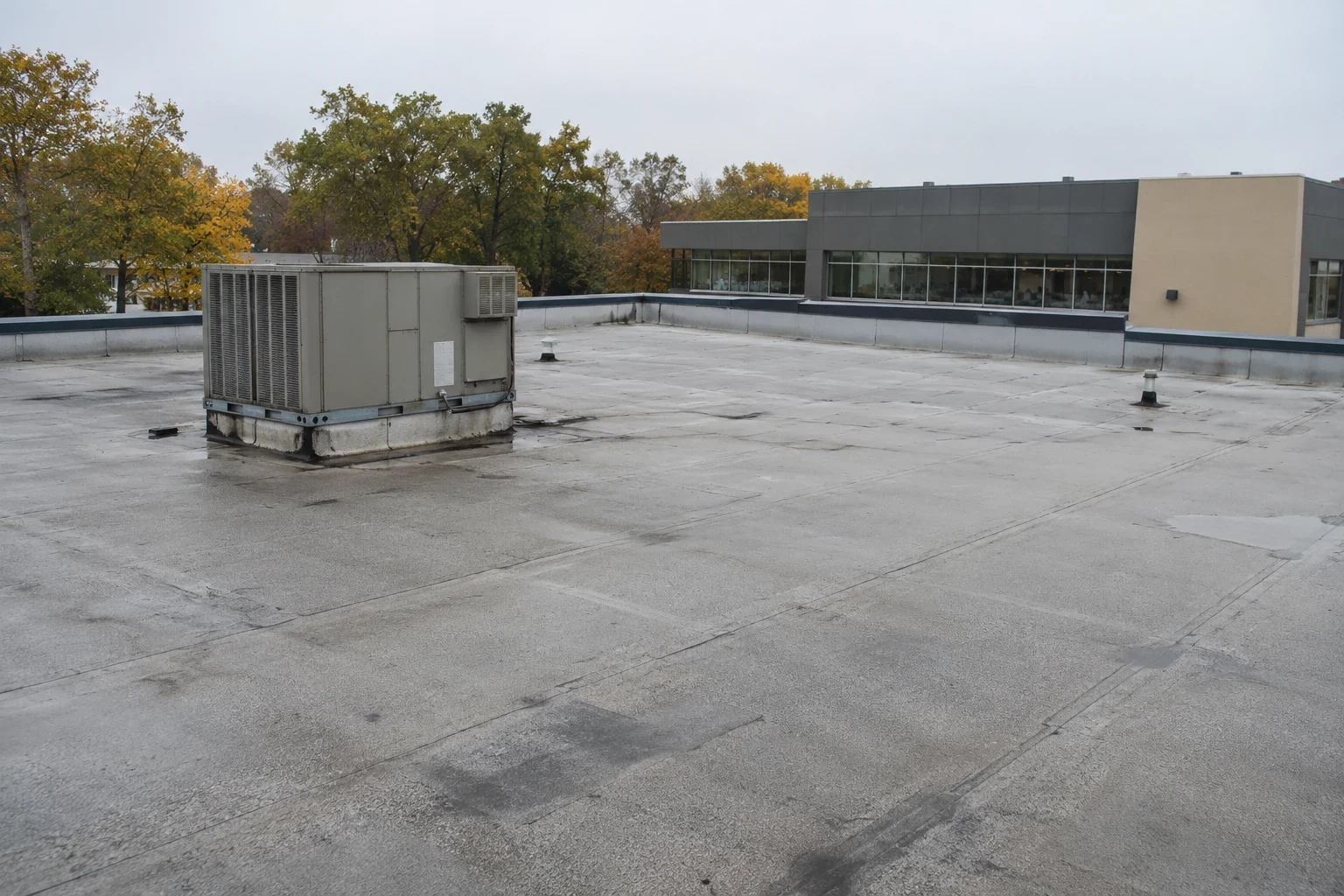
A drip over a frozen-food case is not a maintenance ticket, it is a product loss and a possible food-safety event. Grocery roofs in Springfield, MA carry the condensers, racks, make-up air units and exhaust that keep a store running seven days a week, and the roof membrane around that equipment takes constant service traffic. We start with the equipment layout and the interior leak history, because the room below a leak, whether produce, dairy, bakery or receiving, sets how fast the repair has to move and what protection goes in first. Then the roof walk tests every curb, line set and drain in that section.
Refrigeration equipment sets the roof plan
Condensers, refrigerant lines and heat-rejection equipment are heavy, and they sit on supports that were set when the store was built or last remodeled. Pipe supports shift, sleepers settle into soft insulation and refrigerant line penetrations are flashed with whatever the installer had on the truck. We lay out every support and penetration on a roof plan and check the flashing at each.
Shutdowns are rarely an option. If a line must be moved, we coordinate with the refrigeration contractor and the store manager, schedule the work for the quietest hours and keep temporary protection over the opening. A curb and equipment support repair is planned around the refrigeration company's availability, not ours.
Weight is a quiet issue. A condenser that was swapped for a larger model may now load a deck section beyond what the original design allowed. We note any nameplate changes and pass them to the owner's engineer, since added load shows up first as deflection and ponding around the support.
Condensate and defrost lines freeze in winter
In a four-season climate, condensate and defrost lines that drain onto the roof create ice. A patch of ice at a drain line can block flow, lift a membrane edge or crack a pipe, and the melt later finds the nearest seam. Severe winter storms sit in the high-likelihood group of the state's hazard analysis, and the same cold reaches every rooftop drain line.
We trace each line to its discharge, check for insulation and heat tape where the line is exposed and redirect discharge to a drain or splash pad where practical. This is cheap work compared to an interior leak over a cold case. We also look for snow drifts against equipment, since drifts increase local roof load and hide leaks until the thaw.
Gutters and downspouts on the building edge need the same attention before winter. A downspout that discharges onto a walkway makes an ice patch, and a gutter that holds water pulls on its brackets. We check pitch, outlets and attachment so the edge drains cleanly through the cold months.
Protect product and people before the first cut
Before any section opens, we agree with the store on what sits below it and how to protect it. Overhead plastic, relocated displays and closed aisles are common measures. Food areas get the most careful treatment, and we follow the store's own sanitation rules, which we ask for in writing.
Dust control matters as much as water control. Fresh-air intakes near the work zone are covered or the work is kept away from them. Debris leaves in closed containers, and the roof is swept before the crew leaves. When a section is open, a spotter watches the weather and the interior, and the crew closes the roof when either changes. Occupied building reroofing on a store that never closes follows the same discipline.
Receiving and the back-of-house corridor are the other sensitive zones. Pallets, carts and delivery trucks use them all day, and a roof section above the dock needs a plan that keeps the dock door canopy dry. We schedule that section outside the delivery windows the store gives us.
Find wet insulation before it feeds the case
Wet insulation near refrigeration is a quiet problem. Water held in the board corrodes fasteners, loosens flashing and eventually finds a path to the ceiling. An infrared moisture survey on a suitable day shows temperature patterns that suggest wet areas, and test openings confirm them.
The map gives the owner a firm number: how much of the roof is wet and where. A small, isolated area supports a repair with the rest kept. Wet board across several sections supports a recover with removal in the wet areas, or a full replacement. We price each and explain what the owner keeps and what the owner removes.
Storm history shapes the perimeter check
The Weather Service survey of the June 1, 2011 EF3 tornado places its crossing of the Connecticut River at the Memorial Avenue Bridge, with extensive damage on the south side of downtown. A grocery store may be nowhere near that path, and the lesson still applies: edges, parapets and rooftop equipment are where wind gets a grip.
We inspect the coping, the edge metal fasteners and the securement of equipment covers. Loose items are fixed first, since a panel torn off a unit in a storm can puncture the membrane. After any storm, emergency roof repair starts by sealing openings and documenting damage, then moves to the permanent scope.
Equipment covers and sound-attenuation panels also catch wind. We confirm that each cover has working latches and that panels are fastened to the unit, not just to each other.
Close out with a record the next shift can use
Store managers change, and so do refrigeration contractors. The turnover record outlives both. It lists each roof section, the products installed, the penetrations and the warranty terms, and it marks every curb and support. A roof warranty management file helps the owner keep terms in force through later service work.
Chains with several stores can compare roofs on one scale. Stores in Sixteen Acres or near Forest Park are measured by the same form as any other, and the results feed a big-box retail roof program when the chain also runs larger formats.
A shopping center roof that the store shares with other tenants gets the same record, with the store's section marked clearly.
Commercial Roofing Questions
What happens when a leak appears over a refrigerated case?
We seal the entry point from the roof as soon as it is safe, and the store protects the case and the product. Then we trace the source with moisture mapping and the timing notes from staff. The permanent repair follows once the section is dry enough to bond.
Can refrigeration lines be moved during a reroof?
Yes, with the refrigeration contractor. We coordinate the timing, support the lines during the work and flash each penetration into the new roof system. The store approves the shutdown window in advance, and the line stays protected until it is back in service.
Why do condensate lines damage roofs?
They discharge onto the membrane, where winter ice blocks flow and lifts edges. We redirect them to drains or splash pads and insulate exposed runs. That removes a steady source of wear and a likely source of the next stain.
How do you keep dust out of a food store?
We cover or avoid fresh-air intakes, contain debris and sweep the roof before leaving. The store's own sanitation rules govern the work, and we follow them. A spotter watches conditions below while a section is open.
Does a recover work over wet insulation?
No. It seals water in and shortens the new roof's life. We remove the wet areas first, then recover or replace as the findings support, and the report shows the boundary between the two.