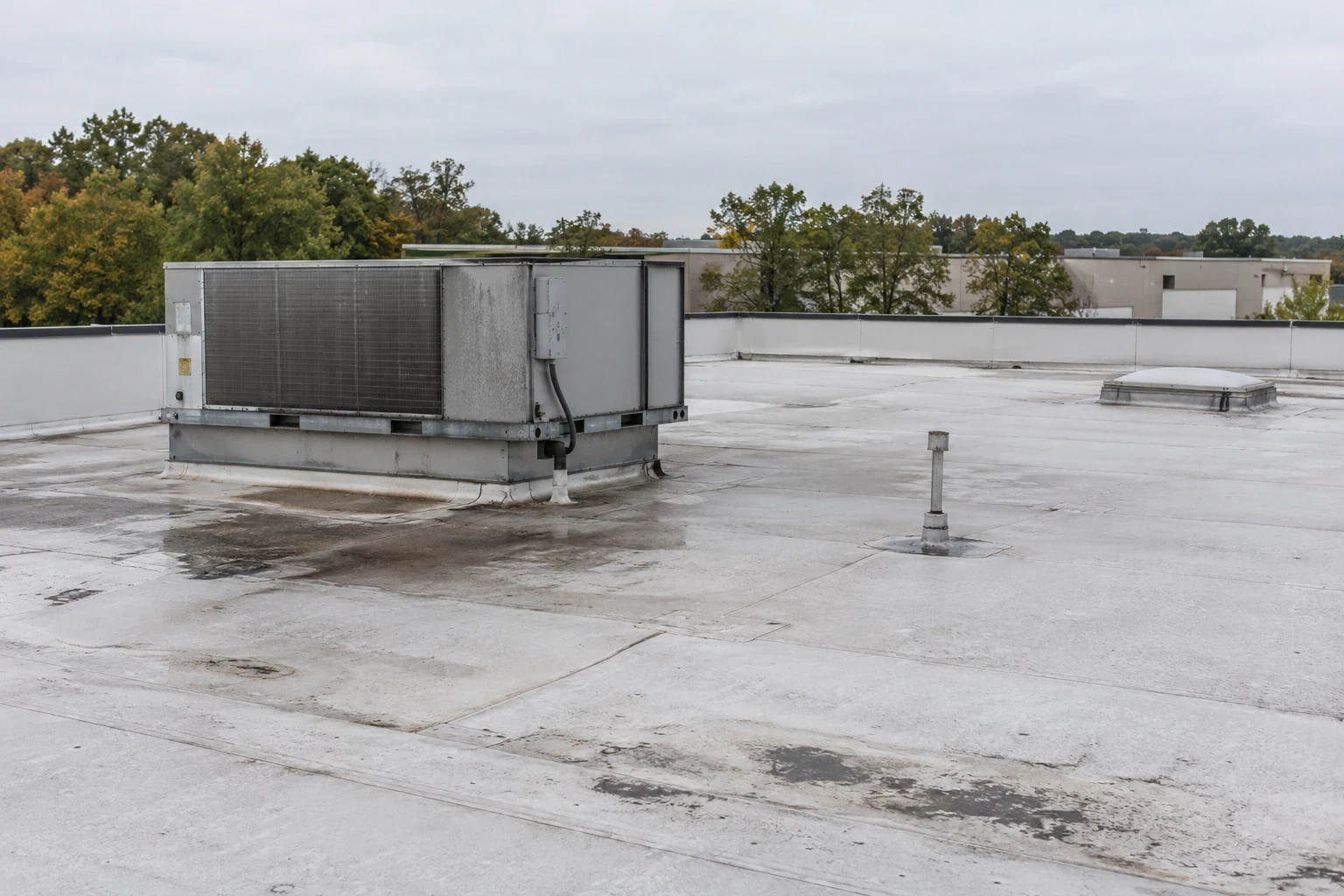
On a big-box roof, the leak that reaches the sales floor is usually the last of several signs. Before that come ponding near a drain, a rooftop unit curb with a split corner and a seam that opened at a wall. Large-format retail in Springfield, MA depends on the arterial and highway network around it: the city's planning page for the Roosevelt Avenue site visible from I-291 also references Route 20A and the Massachusetts Turnpike. A roof of this size has many sections, each with its own condition. We begin by dividing it into those sections and numbering them, because every decision after that, from the access route to the weather window, is made one section at a time.
Divide the roof into sections before anything else
A single large membrane is really a set of fields separated by walls, steps, curbs and expansion joints. Each field drains to its own outlets and has its own history. We mark the fields on a plan, number the drains and record where the repairs sit. That plan becomes the common language between the store manager, the owner and the crew.
With the plan in hand, we survey each field for ponding, open seams, blisters and punctures. We use moisture mapping where the history suggests wet insulation. The result is a table with a condition rating, a repair cost and a replacement cost for each field. The owner can see that two fields are failing while four are sound, which changes the budget conversation entirely.
This division also helps with warranty records. When a field is repaired or replaced, the date and product go against that field's number, so the roof's history is readable years later without digging through invoices.
Drain paths matter more as the roof gets larger
The farther water has to travel, the more a small obstruction matters. A clogged strainer in the middle of a large field can put an inch of water on seams that were never meant to hold it. We trace each drain and scupper path, test flow and check the interior leaders when we can reach them.
Where a field holds water after the drain is clear, we measure the depression and decide between tapered insulation, an added outlet or a corrected sump. In freeze and thaw, standing water becomes ice, and ice lifts seams and splits membrane at the drain bowl. A drain that is clear in October may not be clear in February, so the inspection plan includes a late-winter check.
Rooftop units concentrate the risk
A big-box store typically carries many rooftop units, exhaust fans and vents. Each curb is a place where water can enter, and the traffic of service technicians wears the membrane around them. We map the units, test the flashing at each base and look at the condition of the walk routes.
Clusters of units are the likeliest source of recurring leaks. When a pattern shows up, we propose replacing the curb flashings as a group, with walk pads and corrected condensate lines. Preventive roof maintenance visits twice a year keep those details sealed and give the store a dated record of what was checked.
Rooftop screens and signage frames add to the count. Each bracket that passes through the membrane needs its own flashing, and we check them on the same walk.
Protect the sales floor and the stockroom
The store keeps trading during roof work, so protection starts inside. Before a section opens, we cover or relocate merchandise below, install temporary ceiling protection where needed and agree on a signal with the store manager to stop work if a leak starts. Receiving areas and loading docks stay clear.
Retail calendars matter. Holiday weeks and major sales events are blackout periods for noisy or disruptive tasks, and the schedule respects them. We ask for the dates early, so the largest sections are planned for quieter months. A grocery store roof adds refrigeration load and cold-chain concerns to the same plan.
Large roofs are exposed at the perimeter
A Weather Service survey of the June 1, 2011 EF3 tornado through Springfield found roofs removed from some large commercial brick structures. Big-box roofs are not brick, but the lesson carries: wide roof areas and tall parapets collect wind load at the edges and corners.
We check the perimeter attachment, the coping and the membrane termination, and we verify that fastening patterns match the specified wind design. A mechanically attached membrane that has lost fasteners at the field can billow in strong wind and tear at the seams. When we find that pattern, the report says so and prices the correction.
Recover or replace on the evidence
A roof recover can save tear-off cost and shorten the time the building is open, but only where the existing system is dry and attached. Wet insulation, a corroded deck or multiple prior recovers point toward removal. The TPO roof is a common choice for large fields because it welds at the seams and reflects heat, and the survey decides whether it suits a given store.
Permit review applies where the roof assembly changes. Springfield's Building Division reviews plans against the state code, and the amended commercial energy code can raise the insulation thickness a replacement must meet. We tell the owner at the start whether the project triggers it.
Whichever path is chosen, the tie-in to adjacent roof areas, such as a garden center canopy or a loading dock roof, gets its own detail. Those small roofs often sit at a different height and drain onto the main field, and the water path across the step has to be clear on the drawing before work starts.
Manage many stores with one method
Chains and owners with several stores can put all their roofs on one method. A multi-site roof program uses the same survey form, rating scale and report for every store, so the owner can rank them fairly. Stores near the Boston Road commercial area and the Roosevelt Avenue corridor are measured the same way as any other.
A shopping center roof that shares a lot with a big-box tenant follows its own plan, and the two are coordinated where they meet.
Commercial Roofing Questions
How long does a large retail roof take to replace?
It depends on the area, the system and the weather. The work moves by section, and each section is dried in daily. We give a schedule by section with weather allowances, and we place the largest sections in quieter retail months so the store loses as little trading time as possible.
Can the store stay open during the project?
Usually yes. We protect merchandise and ceilings below each open section, keep receiving areas clear and agree on a stop signal with the manager. Sections over sensitive departments are scheduled for off hours when the store can clear the aisles below.
What is the main cause of repeat leaks on a big-box roof?
Rooftop unit curbs and flashings. Technicians walk the same routes, sealant ages and curbs shift. Replacing a cluster of flashings with walk pads and corrected condensate lines often ends the pattern, and it costs less than repeated call-outs.
Does a mechanically attached membrane need special checks?
Yes. We check fastener spacing, plate condition and seams at the perimeter and in the field. Lost fasteners let the membrane move in wind and wear at the seams, so the report lists the count of missing fasteners by field.
Will the project trigger new insulation requirements?
It can, depending on the scope. Where the roof assembly is replaced, the energy code with Massachusetts amendments may require added insulation. We confirm with the Building Division before pricing, and we state the result in the proposal.