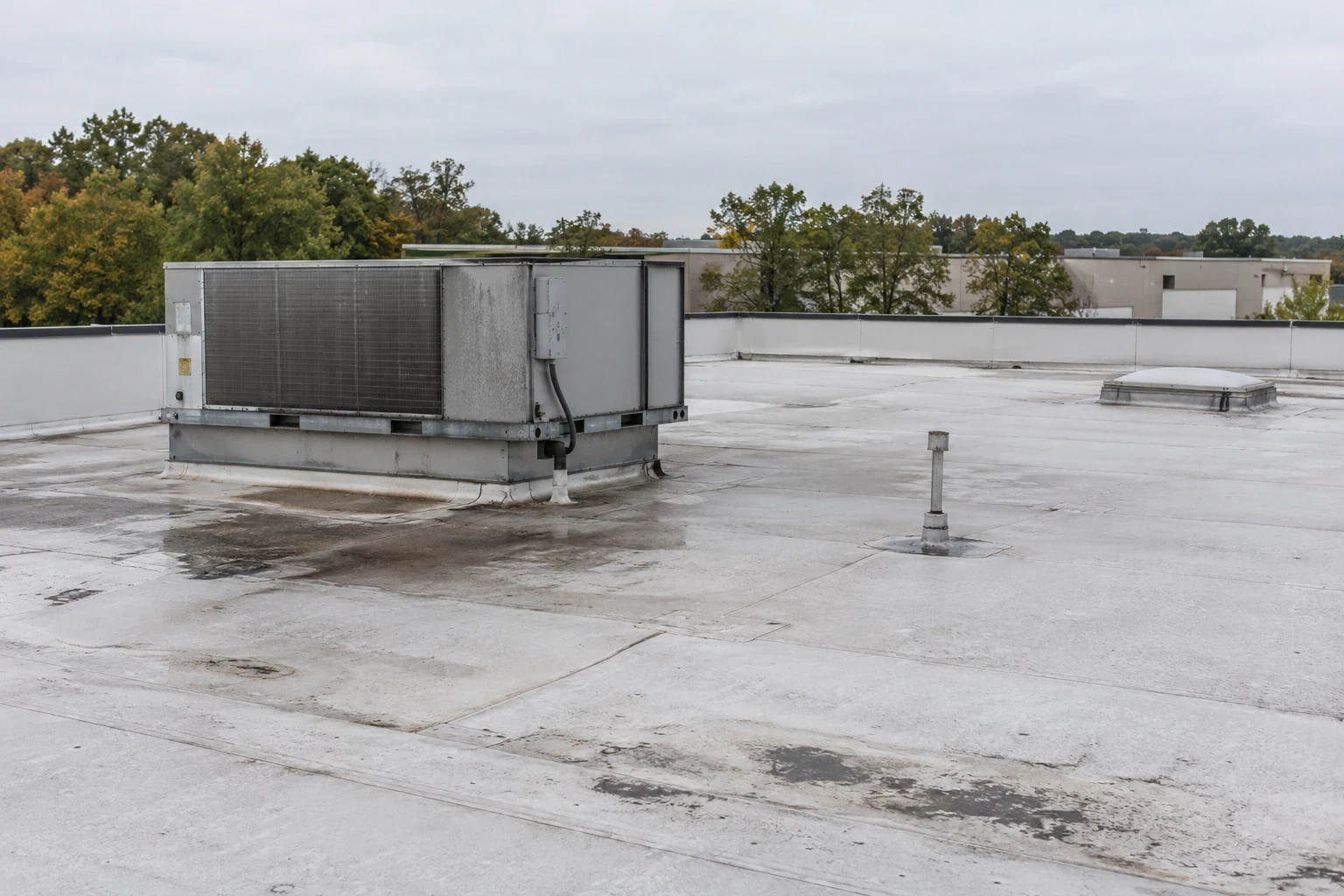
On a strip center, the tenant who calls about the leak is rarely under the roof section that failed. A drip in a nail salon can start at a rooftop unit serving the restaurant two bays down, and the demising walls between bays carry water as readily as air. In Springfield, MA, strip retail and shopping centers sit along corridors such as State Street, which runs 3.2 miles with businesses on its frontage, and in the storefront blocks of downtown streets like Chestnut Street. We start with the interior leak list from every tenant, then walk the roof section by section to match each stain with its source.
Trace the leak to the roof section, not the bay
A shared roof has no bay boundaries. We number the roof sections, mark each unit, drain and penetration, and collect the tenants' notes on when a leak appears: after rain, after a thaw, or only with wind from one direction. Timing separates a drain problem from a flashing problem from a failed seam.
Then we test. Water travels along the deck flutes and insulation joints, so we use moisture mapping to follow it and test openings to confirm. The result is a roof plan that shows wet areas, sound areas and the sources. A targeted repair can fix a single source. When the map shows wet insulation across several sections, the owner needs a replacement estimate, not another patch.
The tenant notes are worth collecting even on a roof that looks bad. A bay that has never leaked, in the middle of a failing roof, tells us where the system is still sound and where a repair boundary can be drawn.
Snow drifts and ice dams work on the canopy edge
Strip centers often have a front canopy or a stepped parapet. Snow drifts against the step, melts slowly and refreezes at the eave, and the resulting ice works under flashing and edge metal. Massachusetts planners expect severe winter storms, and the state's hazard analysis counts roof damage from snow and ice load as one of their effects.
We inspect the canopy edge, gutters and the flashing at the step. Loose coping and open laps are the first things that ice finds. For recurring ice dams, the fix is usually at the eave: better ventilation, a corrected gutter or an ice-resistant edge detail, and our edge metal, coping and gutters work addresses them. Roof snow removal, if the owner wants it, needs a plan that protects the membrane from shovels.
Tenant equipment multiplies the penetrations
Each tenant improvement can bring a new rooftop unit, exhaust fan or vent. Over the years, a strip roof collects penetrations installed by different contractors, with different flashing methods. Some are sound, and others are sealant over a gap.
We count them, check the flashing at each one and ask the property manager for the tenant work history. A curb and equipment support cluster over one bay is the likeliest cause of repeat leaks. Where a tenant needs a new unit, we coordinate the curb and flashing with the roof, so the opening is made once and made right. Abandoned curbs and capped pipes are removed or sealed as part of the same visit.
Keep the lot, the walks and the loading doors open
A shopping center earns its rent from the lot and the sidewalk. The work zone, hoist and debris container need to sit where they do not block parking, fire lanes or the loading door that a grocery or pharmacy uses. We draw the staging area on a site plan and share it with the property manager before the first delivery.
Hours matter as much as space. Early starts avoid peak shopping hours, and noisy tasks over a restaurant or salon are scheduled around its service times. Each roof section is closed in by the end of the shift, and the crew sweeps the lot and walks for fasteners and debris. A restaurant roof bay has extra steps for grease and exhaust.
Wind history makes perimeter securement a priority
The EF3 tornado of June 1, 2011 cut through Springfield and, per the Weather Service, damaged large commercial brick structures and took the roofs off some. Most strip centers will never see that, but the lesson holds for any retail roof: wind starts at the edge. Lifted coping, loose edge metal and open perimeter flashing let air under the membrane.
We check the perimeter attachment, fastener spacing and the condition of the membrane at corners, where wind loads peak. If the edge is weak, the perimeter gets fixed first. Snow and ice roof damage repair follows the same sequence: secure the edge, dry the water path, then repair the field.
Choose between repair, recover and replacement on the evidence
The decision depends on wet insulation, seam condition and remaining service life. A roof with isolated defects and dry insulation can be repaired. A sound but weathered membrane over dry board may take a recover or a coating. A roof with wet insulation across several sections, or with repeated failures, is a replacement candidate.
We give the owner all three costs and the effect on tenants. A permit review comes into play when the work changes the roof assembly, and Springfield's Building Division reads the plans against the tenth-edition state code. We build that review time into the schedule so the start date is real.
Run several centers on one plan
Owners with several centers can rank the roofs by leak history, condition and tenant exposure. A multi-site roof program sets one inspection method and one reporting format for all of them. The owner sees which center to fund first and which can wait a year.
Centers along State Street and in the downtown blocks near Chestnut Street have different tenants and traffic, so the plan treats each one on its own findings. A big-box retail roof in the portfolio gets the same measures, with its own staging plan.
The plan also names the next work package for each center, with its cost range, so the owner can set the budget a year ahead and not react to the next call.
Commercial Roofing Questions
Why does a tenant's leak not match the roof above it?
Water travels along decks, insulation joints and demising walls before it drops. We trace it back with moisture mapping and each tenant's timing notes, then confirm the source with a test opening. The stain tells us where water arrived indoors, and the roof plan tells us where it entered.
Can one tenant's rooftop unit damage the whole roof?
Yes, if its curb or flashing fails, or if technicians wear a path through the membrane. We check each curb, add walk pads along service routes and flag units whose condensate drains onto the roof. One unit can send water into three bays.
What stops ice dams at a canopy edge?
Better ventilation, sound flashing and a corrected gutter or edge detail. Ice forms where heat leaks from the building and melts snow near the eave, so we check insulation and ventilation along with the metal. We inspect the canopy edge before winter, not after the first dam.
When is a coating enough for a strip roof?
When the insulation is dry and the seams are sound. Moisture mapping and a few test openings confirm both. A coating over wet insulation traps water and shortens the roof's life, so we do not propose one there.
How are tenants told about the work?
The property manager sends a written schedule with dates, hours and the bays affected, and we supply the content. A named site contact answers questions during the work. Tenants with sensitive stock get notice of the day their section opens.