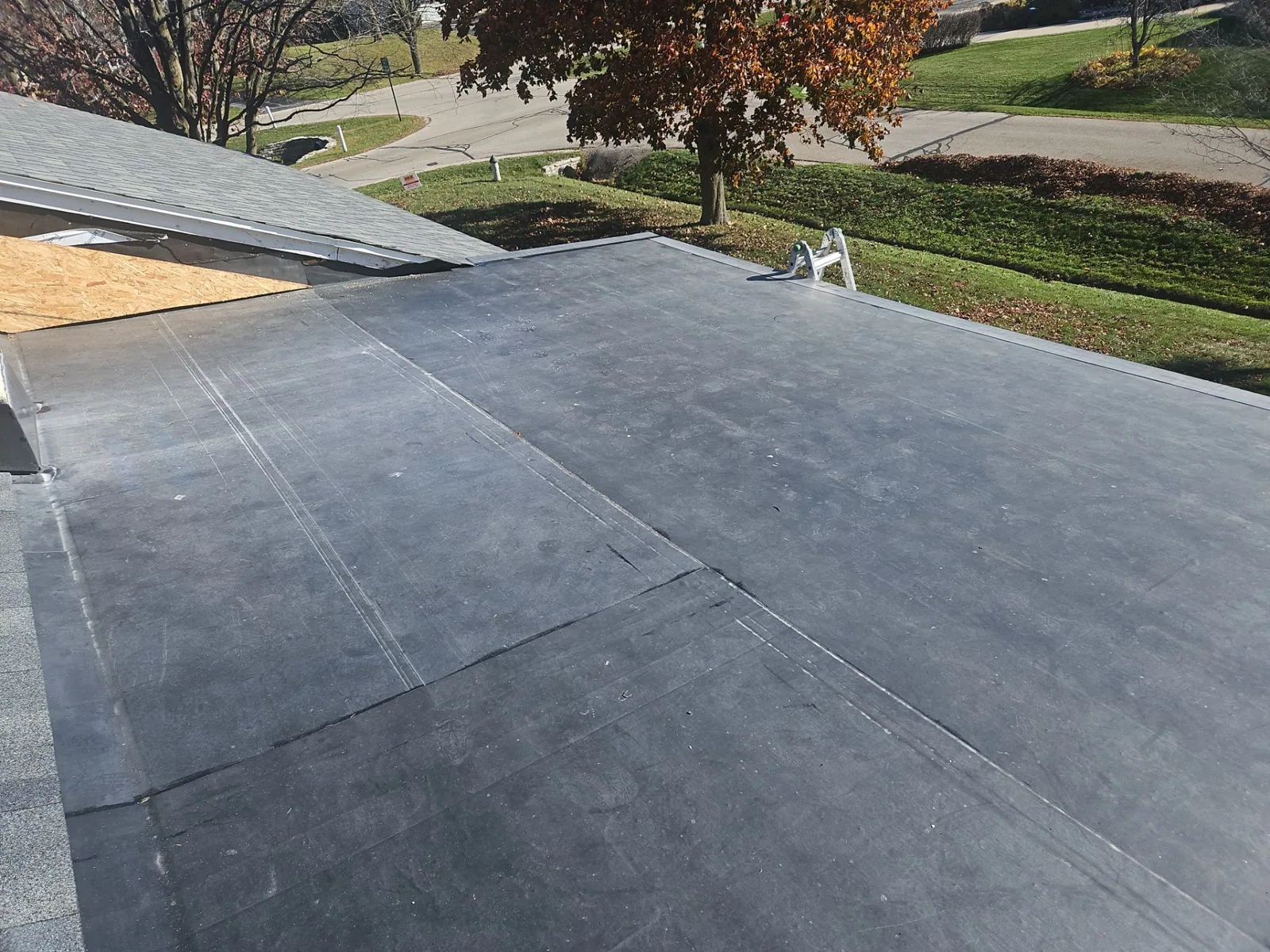
A flame, a roll of cap sheet and a downtown tenant who is still at the desk three floors below: that is the situation on a downtown bitumen job, and it shapes the whole plan. Soprema supplies modified bitumen membranes under the Sopralene name and liquid-applied flashing resins such as Alsan, two approaches that fit different details on the same Springfield, MA roof. Choosing between torch, hot-mopped, self-adhered or cold-applied methods is a safety decision as well as a materials decision, and we make it after we see the roof, the deck and what sits beneath it.
Everything else about the repair follows from that first choice.
Cap sheet laps and granules
A bitumen cap fails at its laps, its flashings and its worn surface. We probe each lap for open edges, look at end joints where rolls meet, and check how far the granule surface has worn away. A cap with exposed asphalt in the field ages quickly under sun and cold cycling. Where laps have opened but the sheet is flexible, a re-sealed lap or a patch can hold. Where the cap has become brittle, patches crack at the edge and we recommend a section replacement. Layered modified bitumen systems hide their condition between plies, so cores come before conclusions.
Flashings deserve a second look. A cap sheet turned up a wall depends on its top edge being secured and sealed, and on the base flashing having been set into a compatible adhesive. Where the top edge has opened, water runs behind the flashing and appears inside as a wall stain, which is easy to mistake for a roof leak in the field. We probe each flashing, note the ones that sound hollow and mark the length that needs rebuilding.
Choosing a method for an occupied building
Open-flame work needs hot-work permits, fire watches and combustible-free zones, and some building owners rule it out. Self-adhered and cold-applied systems avoid the flame but depend on a clean, dry deck and workable temperature. We discuss the options with the owner, the insurer and the fire official where required, then document the method in the work plan. On an occupied building, the plan also covers smell, noise and the hours the work is allowed. Whatever the method, the crew keeps extinguishers, a fire watch and a closeout inspection in the daily routine.
Insurers and fire officials may have their own requirements, and the owner often holds the policy that sets them. We ask for those rules early and record them in the work plan, because a method approved on paper but refused at the site costs more time than a slower method chosen at the start.
Liquid flashing at awkward details
Pipes, conduit clusters, irregular curbs and corners where sheet flashing will not lie flat are hard to detail. A liquid-applied flashing resin flows around them and cures into a continuous, bonded layer. The resin needs a clean, dry and compatible surface, and it is applied in measured thickness with reinforcement where the detail calls for it. On a roof with many equipment supports, liquid flashing can solve problems that sheet goods cannot, as long as the substrate and the primer are right. We test adhesion on a small area before covering a whole detail.
The tradeoff is that resin work is only as good as the surface under it. Rust on a metal base, dust on old bitumen or moisture trapped below can break the bond. We prime where the system calls for it, record the thickness and keep a sample of each mix for comparison, so a later inspection can check the work against what was specified.
Downtown roofs and tight access
Court Square is an urban renewal planning area in Springfield's central business district, with a plan that dates to 1970 and has been amended since. Nearby, the 2021 Northeast Downtown plan studies Chestnut Street and its storefront activity, parking and pedestrian circulation. For roofs in that part of the city, the lift position, the street staging and the ground-level pedestrian route control the schedule. We lay out the work zone on a sketch, protect walkways and agree on delivery windows before any material arrives. A roof section left open overnight in the Court Square area would affect the building below directly.
The Northeast Downtown plan also names older downtown infrastructure and vacant or underused parcels among the constraints on redevelopment. Whatever the parcel looks like from the street, we find out which floors are occupied before we plan the work, because a quiet building can still hold stock or equipment that water would ruin.
Cold, ice and thaw
Massachusetts' ResilientMass plan lists snow and ice weight on roofs as an impact of severe winter storms. Bitumen roofs stiffen in the cold, and cold-applied materials need minimum temperatures, so winter work is limited to emergency protection and drain clearing. Ice at a clogged drain loads the membrane at its weakest point, and a snow and ice damaged roof usually shows its splits after the thaw. We plan permanent repairs for the first stable weather in spring and mark the temporary work clearly in the record.
Meltwater is the usual trouble. A sudden thaw sends water over a roof that is still partly frozen, and drains blocked by ice push it toward parapets and flashings. A walk right after the first thaw finds new openings while they are small, and a quick patch with compatible material buys time until the weather permits a durable repair.
Records and permit review
A replacement clears permit review before material is delivered; the 780 CMR 10th Edition applies, and the Building Division checks alteration and repair plans. Our turnover record names the membrane family, the method used, the hot-work controls, the repair limits and the photographs. When the neighboring section is Duro-Last or GAF material, the junction is drawn so the next crew sees where one system ends.
Any manufacturer warranty gets read for its notice and repair terms before work begins, and the correspondence goes into the same file. A single folder with photographs, test results and permits lets the next contractor continue without repeating the survey.
Commercial Roofing Questions
Does every Soprema roof need a torch?
No. Self-adhered and cold-applied methods exist alongside torch and hot-mopped work. The choice depends on the deck, the building use and the owner's fire rules, and we state the method in the plan before the first roll is opened.
What is liquid flashing used for?
It seals irregular details such as pipe clusters, odd corners and curbs where sheet flashing will not lie flat. The resin bonds to a clean surface and cures in place, so surface preparation decides how well it performs.
Can a bitumen cap be repaired in winter?
Only as a temporary measure. Permanent repairs need dry, workable weather. We install protection, mark the opening in the record and return in spring when materials can bond correctly.
How do you protect tenants below during hot work?
With a hot-work permit, a fire watch and clear zones around the work. We also agree on hours and daily closeout with the building contact, and the crew checks the area under the work before leaving each day.
What documents should I gather first?
Any roof plan, repair history, warranty paper and the leak locations. A photo of the roof surface also helps. If the owner has insurer requirements for hot work, send those too.