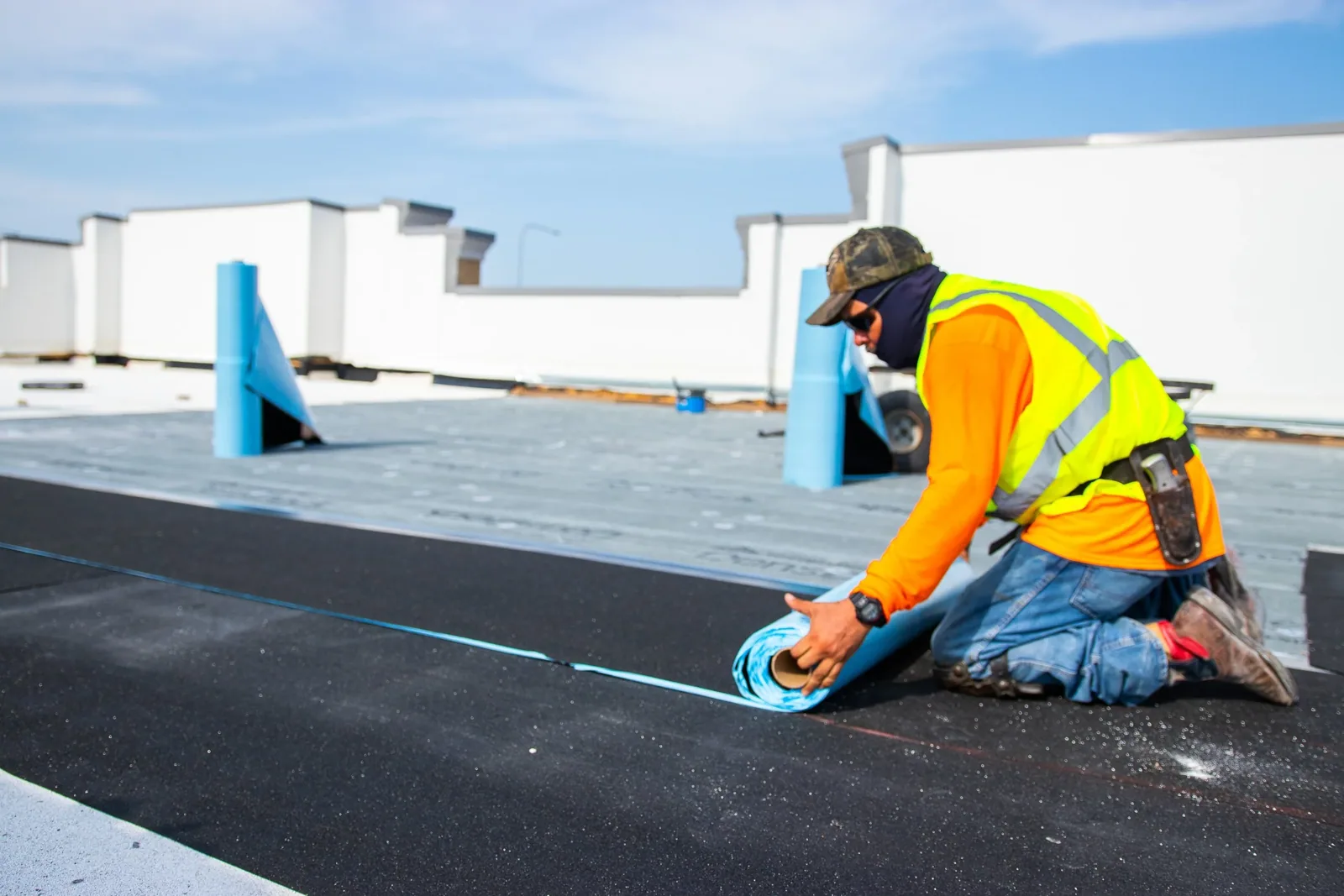
Most of a Duro-Last roof was assembled in a factory long before the first sheet reached a Springfield, MA building. The maker fabricates white PVC membrane to the measurements of each roof, with the flashings, corners and pipe boots made as separate pieces, then ships it rolled to the job. That approach leaves fewer field seams than a conventional single-ply roof, and it moves the trouble spots to a short list: the seams between panels, the attachment at the perimeter, and the field-made details around anything that was added after the measurements were taken.
We begin a repair by finding those spots.
A repair on a prefabricated roof is also easier to document. Panel lines give a natural grid, so we can say that the leak sits two panels from the north wall and the fix covers a defined length of seam, which is more useful to an owner than a general description of the roof.
Find the panel seams
The seams between prefabricated panels are welded on site with hot air, and they are the main place to probe. We walk each panel line, mark any lifted edge and check how the panel is attached at the perimeter. Because the sheet is cut to fit the building, a repair that needs new membrane can use a patch cut from compatible PVC sheet, and an area that is beyond patching may call for a custom piece made to the measured shape. Knowing where the panel seams run also tells us how the roof was laid out, which helps us read the drain slopes and the load paths.
A seam failure in this kind of roof tends to show along one panel line, not scattered across the field. If several lines are failing at once, the cause is usually attachment, ponding or shrinkage at a perimeter, and a patch will not cure it. We mark the pattern on the plan and recommend the broader fix when the pattern justifies it.
Factory flashings and field changes
Prefabricated boots, corners and curb wraps fit cleanly when the roof is unchanged since measurement. After a new rooftop unit, a vent or a conduit run is added, the fit gets harder. A crew then makes a field flashing from pieces of sheet, and the quality of that detail decides whether it leaks. We inspect each altered penetration, check skylight and penetration flashing for bond and note which details are factory made and which were added later. The difference shows up in the weld pattern and in the cleanliness of the cut.
Drains are the other detail to confirm. A drain sump that was set a little high, or a strainer that has been missing for a season, can keep water on the sheet beside it. We clear and check each drain and scupper and note any that need a new ring or a lower seat.
Surface condition and cleaning
A white PVC surface collects dirt, and heavy buildup can hide small cracks. Before any patch is welded, the area must be cleaned with a method that suits the sheet, because oils and dirt block the weld. We also check for contamination near exhausts, since grease can soften the membrane over time. On a PVC roof, the cleaned surface should accept a trial weld, and if it does not, we widen the cleaning or mark the area for replacement.
Cleaning is documented like any other step. We note the method, the area and the result of the trial weld, and we photograph the surface before and after. If the owner later asks why one patch was welded and another was replaced, the record answers.
Retail strips and campuses
Commercial property along the Boston Road commercial corridor, in eastern Springfield beside the Wilbraham line, and institutional land such as Western New England University in the Sixteen Acres neighborhood are the kind of setting where a multi-section roof can turn up. Wherever a prefabricated roof has several sections, each one can be measured and covered in turn. In practice that means the crew finishes one roof section before opening the next, and the owner sees dry, welded work at the end of every day.
Where a site has additions of different ages, a prefabricated roof may sit beside older sections made of other materials. Each junction is a tie-in that needs its own flashing, and we walk those first. A campus with many buildings also benefits from one inspection format, so the facilities team can compare roofs across the site and decide where to spend first.
Snow, thaw and attachment
The state's 2023 ResilientMass plan lists snow and ice weight on roofs among the impacts of severe winter storms. A mechanically attached PVC sheet depends on its fasteners and plates to resist uplift and to hold position under drifting snow. We check plate condition at the perimeter, look for ripples that suggest loosened attachment and clear drains before the first heavy freeze. A thaw that sends meltwater against a loose edge is a common way for a small defect to become a leak, so edge checks follow every major storm.
Ice also forms at the eaves where heat escapes from the building. A roof that melts snow from below and refreezes it at the edge builds a ridge that holds water behind it. We check insulation at the perimeter and recommend changes when the pattern is clear.
Matching the repair and the record
A replacement of a prefabricated roof goes through permit review under the 780 CMR 10th Edition, which the Building Division applies in Springfield. Because the new sheet is made to order, measurements are taken early and checked against the roof plan, which allows the order to be placed with the right lead time. The turnover record lists the panels found, the repairs and their limits, and the photographs. If a nearby section uses Sika Sarnafil or Versico material, the junction is shown on the plan.
The first repair after a permit-reviewed replacement is often a small one, so the closeout includes a short list of what to watch in the first year: edges after the first freeze, seams after the first heat, and drains after the first heavy rain. For owners who need commercial roof repair before a larger project, that list guides the order of the work.
Commercial Roofing Questions
Can a Duro-Last roof be patched?
Yes, with compatible PVC sheet welded to a clean surface. The patch has to bond fully at the edge, so we probe it after welding and photograph the result for the file.
What does prefabrication change for repairs?
The factory-made flashings and panels limit where field welds occur, so the panel seams and altered details are where we look first. A repair needs sheet that matches the installed PVC, and we confirm it before cutting.
How long does a replacement take to order?
Lead time depends on measurements and the maker's schedule. We take measurements early and verify them against the roof plan, so the order is not the last item waiting when the weather window opens.
Why is the surface cleaned before welding?
Dirt and oil block the weld. A clean surface lets the patch fuse to the sheet instead of sitting on top, and it lets the probe show a true result. We test a small area first and record the result.
Which details speed up a first visit?
The roof area, the leak pattern, the access limits, any plans or warranty paper and the schedule you need. A note on any equipment added since the roof was installed helps us find altered details.