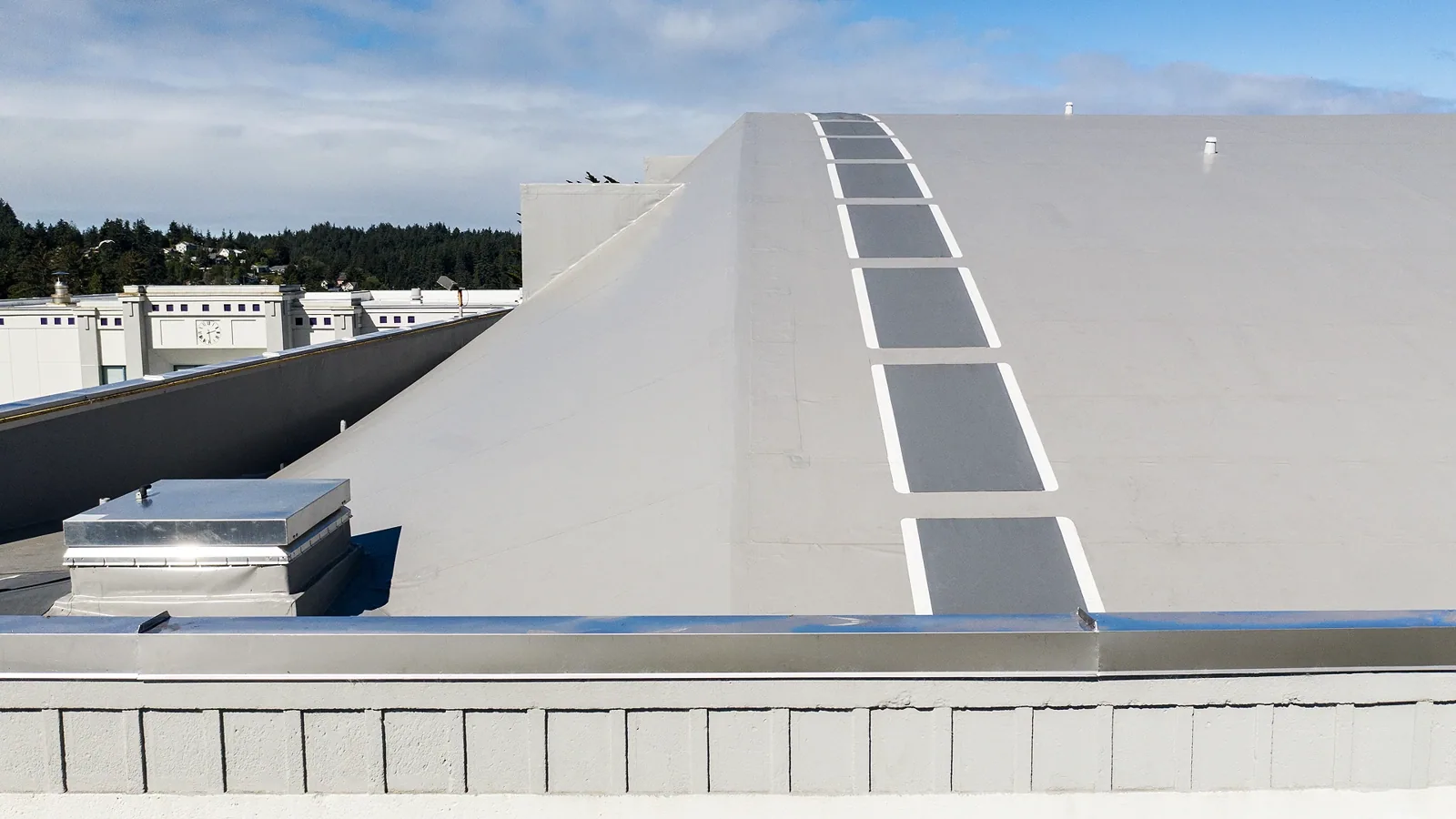
A GAF name on a submittal tells the owner who supplied the sheet or the cap layer, not which kind of roof is actually overhead. The maker's commercial lines run from heat-welded single-ply to granulated modified bitumen, and the repair method is different for each. On a commercial building in Springfield, MA, the first job is to find out which family the roof belongs to and how much of it is still sound. That answer decides whether the next step is a patch at a tie-in, a recover, or a tear-off to the deck. We work through it in a fixed order so the finding is on paper before anyone orders material.
Read the roof before the label
The roof walk starts with the surface. A smooth white or gray sheet with a welded lap is a thermoplastic. A rough, granule-covered surface with overlapping rolls is a bitumen cap sheet. Older buildings often carry both, because a previous owner added a new section beside an old one. We cut one small test opening at a low corner, note the layers and the insulation type, and close it with a temporary patch the same day. The opening shows what is below the surface, which a label never will.
If the roof plan or the warranty paper is available, we compare it with what the cut shows. When the two disagree, the cut governs the repair.
Welded single-ply: seams first
On a thermoplastic sheet, the weak points are the welds and the details. We run a probe along each lap, mark any spot where the edge lifts, and check the flashing at curbs and walls where the sheet changes direction. Weathered membrane must be cleaned before a new patch is welded, or the patch sits on the surface and peels. Hot-air welding also needs dry sheet and a workable temperature, so the weather window shapes the day.
The same seam logic applies to any TPO roof we find. Corners and T-joints get the slowest pass with the probe, because the stacked layers there are where a weld is easiest to miss. A weld that looks fine at the edge but was never cleaned underneath will pass a glance and fail in the first freeze, so the probe goes along every foot we mark for repair.
Bitumen caps: laps and granules
A modified bitumen cap fails differently. Granules wear off and expose the asphalt layer to sun, laps open at the end joints, and flashings split where they were turned up a wall. We look at how the laps were sealed, whether the base layers are dry, and whether the surface can still take a repair. Where the insulation under a split is wet, a surface patch will not hold. A moisture survey, such as an infrared scan, marks the wet area before anyone decides how big the removal needs to be. Layered modified bitumen assemblies hide their condition between plies, so we also check the base sheet where the cap has blistered.
Repair, recover or replace
The decision follows the moisture map. Dry insulation under a sheet or cap with life left points to local repair, with laps re-welded or re-sealed to carry the roof through another cycle. Dry insulation under a spent surface points to a recover, which adds a layer without full tear-off when the deck, the structure and the code permit. Wet board in several roof sections points to removal of the insulation and the old cover together, because a new layer over wet board only moves the leak.
Cover board matters in this choice. A new sheet laid over soft or uneven insulation shows every flaw, so we price cover board as part of the recover, and we state the removal boundary in feet on the roof plan. The owner sees the repair cost, the recover cost and the replacement cost side by side, each tied to what the test cuts found.
Snow load and tornado wind
Massachusetts planners flagged roof damage from accumulated snow and ice in the 2023 ResilientMass plan, which rates severe winter storms a high-likelihood hazard for the state. For a GAF roof that means drain paths and edge details get tested every winter. Springfield also has a wind record that owners cannot ignore: a National Weather Service survey of the June 1, 2011 EF3 tornado found roofs torn from some large commercial brick buildings along its Springfield path. Perimeter securement and edge metal are the first checks after any wind event, and they matter on every membrane family. A tornado-damaged roof is inspected at the edges before the field.
Access downtown, in the district and on large roofs
Downtown roofs in Metro Center, where government, business, cultural and institutional buildings sit together, often depend on street-side staging and tenant hours. In the Medical District, which the city's 2011 study put at roughly 315 medical and health services establishments, the work zone has to protect air intakes, entrances and patient routes. We set the access route and the daily closeout with the building contact before the first sheet is lifted, because a roof section left open overnight in a thaw-and-freeze week is a leak waiting to happen.
Industrial roofs in places like Chicopee, where the Westover Metropolitan Development Corporation reports four industrial parks, call for a drain-path-first walk. Westover Air Reserve Base, about five miles from Springfield city center, recorded 20 inches of snow in the February 2013 storm, a reminder of what a single event can load onto a roof. On a GAF roof like that, we walk the drain paths first, clear strainers, check scuppers and mark ponding areas. Rooftop units and exhaust fans each get a curb detail check, since a failed curb flashing is among the most common entry points on a large roof.
Permit review and turnover record
Springfield's Building Division enforces the state code, which is currently the 780 CMR 10th Edition, and reviews plans for alterations and repairs. A recover or tear-off normally goes through permit review before material arrives. When the owner holds a manufacturer warranty, the notice and the approved repair steps need to be checked first, and the warranty management file keeps them in one place. The turnover record then lists the layers found, the repairs made, the limits of each repair, and the photographs of every opening. A later contractor, such as one working with Carlisle SynTec or Johns Manville material on a neighboring section, can read it and continue without guessing.
Commercial Roofing Questions
Can I repair a GAF roof with another maker's patch material?
Only if it bonds to the installed surface and suits the family. Mixed materials often lift at the edge, so we match the patch to the sheet or cap found in the test cut. A thermoplastic patch will not hold on a bitumen cap, and the reverse is also true.
How do I tell a single-ply GAF roof from a bitumen one?
Look at the surface and the laps. A smooth sheet with welded seams is single-ply. A granulated surface over overlapping rolls is bitumen. If both appear on one building, there are likely two roof sections of different ages. A test cut confirms the layers.
Does a repair void a warranty?
It can, if the terms require notice or approved steps and those were skipped. Send the paper first. We read the notice requirements and the repair limits before work starts, and we keep the letters in the turnover file.
Can the old roof stay and a new layer go over it?
Sometimes. The insulation must be dry, the deck sound and the code must allow another layer. Wet areas are cut out before any recover. The moisture survey decides how much of the old roof can stay.
What helps most before the first walk?
The roof area, the leak pattern, access limits, any warranty paper and the date you need an answer. A roof plan helps, but photographs of the leaks and the nearest drain are enough to plan the first walk.