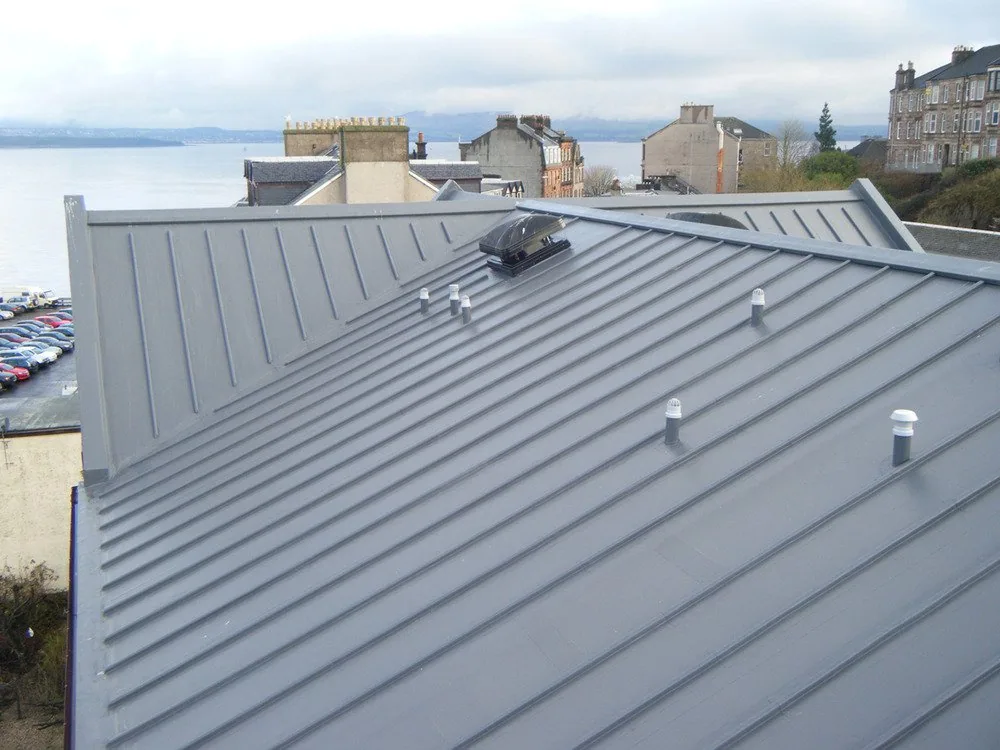
Black rubber and white thermoplastic can both carry the Carlisle SynTec name, and they fail in different places. An EPDM sheet loses its seam tape or its flashing bond. A TPO sheet loses a weld. The Springfield, MA owner who needs a repair has to know which one is overhead before anyone mixes adhesive or heats a welder. We start every Carlisle roof with that identification, because the product lines such as Sure-Seal and Sure-Weld use different seam methods, different cleaners and different patch materials. Getting the family right at the start keeps a repair from becoming the next leak.
Rubber or thermoplastic
The quick test is the seam. A rubber membrane is joined with tape or splice adhesive, and the lap has a visible edge of sealant. A thermoplastic membrane is joined by hot-air welding, and the lap shows a smooth bead. Color helps but does not settle it, since both come in white. We cut a small sample from a low corner, check the scrim and the backing, and note the insulation below. The sample goes in the file with a photograph. If the roof has been patched before, we record every patch material found, because mismatched materials are a common source of repeat leaks.
The sample also tells us whether the sheet is fully adhered, mechanically fastened or ballasted. Each attachment fails in its own way: a fastened sheet flutters and loosens plates, an adhered sheet loses bond at the edges, and a ballasted roof hides its condition under stone. Knowing which one we have decides how we open the roof and where we expect the trouble to be.
Rubber roofs: tape, adhesive and flashings
On an EPDM roof, the problems cluster at splices, around penetrations, and at the flashing where the sheet turns up a wall. Splice tape can creep under heat and shrinkage, and field-applied flashing can pull away from a masonry parapet. Repairs need a clean, dry surface, which in New England means a weather window, not a calendar date. Cold, damp days make adhesives unreliable, so we schedule bonded repairs for dry spells and use temporary protection when the forecast closes the window. A rubber membrane that has shrunk will pull at its terminations, and no patch fixes.
Pipe boots and pitch pockets deserve a close look as well. A molded boot cracks in sun and cold, and a pitch pocket shrinks away from the pipe it was poured around. Replacing a boot costs little next to the interior damage it can cause, so we list every penetration on the report with its condition, even those that are not leaking yet.
Welded roofs: probe every lap
For a welded sheet, the probe is the main tool. A good lap resists a blunt edge and shows a continuous bead. We mark each spot where the edge lifts, then clean and re-weld or patch it. The details matter more than the field of the roof, so we spend time at corners, curbs and drains. How a TPO sheet weathers also affects the repair, since a heavily aged surface must be cleaned before a new weld will bond. Where welds fail repeatedly across a roof section, replacement of that section becomes more economical than another round of patching.
Each repair also has to match the membrane. A patch of the wrong thermoplastic, or one that was only glued, lifts at the edge and looks like a new leak within a season. We record the patch material and the weld settings on the closeout sheet so the next crew can repeat the repair.
Freeze, thaw and drain paths
The 2023 ResilientMass plan names roof damage from heavy snow and ice among the effects of severe winter storms, and the same analysis rates those storms a high-likelihood hazard. On a single-ply roof the consequence is concrete: water that cannot reach a drain freezes at the seam and works it open. We trace the drain paths, check that strainers are clear, and look for low spots that hold ice. A cracked drain bowl or a bowl that sits proud of the membrane goes on the repair list, not the maintenance list.
Edges take the first punishment. Ice dams behind a gutter or an edge metal run can back water up under the sheet, and loose coping lets wind get under the perimeter. We check fasteners and sealant on every edge run, because a single loose section can start a peel that travels across the roof.
Corridors and parks
Springfield's 3.2-mile State Street corridor mixes businesses, residences, parks and institutions, so roof access runs from street staging to rear alley lifts. At Indian Orchard Business Park, where the Springfield Redevelopment Authority reported full occupancy in May 2022, multi-property use means neighbors share drives and a roof approach. We confirm the access route and the work zone with each building contact, and we plan the daily closeout so a section opened in the morning is dry by evening.
On downtown lots, the lift location can control the schedule. A rear alley may be blocked by deliveries, and a street closure needs a city permit. We ask for those limits up front and build the work zone around them, so the roof section does not stay open while the crew waits on access.
Closeout and permit review
A recover or replacement goes through permit review first: the governing code is the 780 CMR 10th Edition, and the city's Building Division looks at plans for repairs and alterations. The turnover record lists the sheet type, the layers, the repairs and their limits, and the photographs. Where a manufacturer warranty exists, we read its notice terms and approved repair steps before work starts. The same method applies when the previous roofer used Versico material on an adjacent section or when the building has an older repair history that has to be reconciled.
Where two makers' sheets sit side by side, the closeout also marks the tie-in between them. That junction is where moisture most often finds a way in, and the next contractor needs to see how it was made, such as a GAF section adjoining a Carlisle one.
Commercial Roofing Questions
Is a black roof always EPDM?
Almost always, but we confirm it. A sample from a low corner and a look at the seam method settle the question. Some roofs carry a black rubber field with white thermoplastic flashings added later, and the repair must suit each part.
Can a failed splice be fixed in winter?
Often only as a temporary repair. Adhesives and tapes need a dry, workable surface. We close the opening with temporary protection and finish the bonded repair in the next weather window. The temporary work is photographed and listed on the closeout.
How long does a seam repair take?
A targeted visit can be short once access is set. The probe and survey take most of the time, and the repair itself is quick on a clean, dry sheet. Larger runs of failed seam turn into a section replacement decision.
Do I need the original warranty paper?
It helps. The paper names notice requirements and approved repair steps. Without it, we document what we find, with photographs and test results, so the repair record stands on its own for the next owner.
Can a Carlisle roof be recovered with another layer?
Yes, when the insulation is dry, the deck holds fasteners and the code allows it. Wet areas are removed first, and a cover board usually goes down before the new sheet. The moisture survey sets the removal boundary.