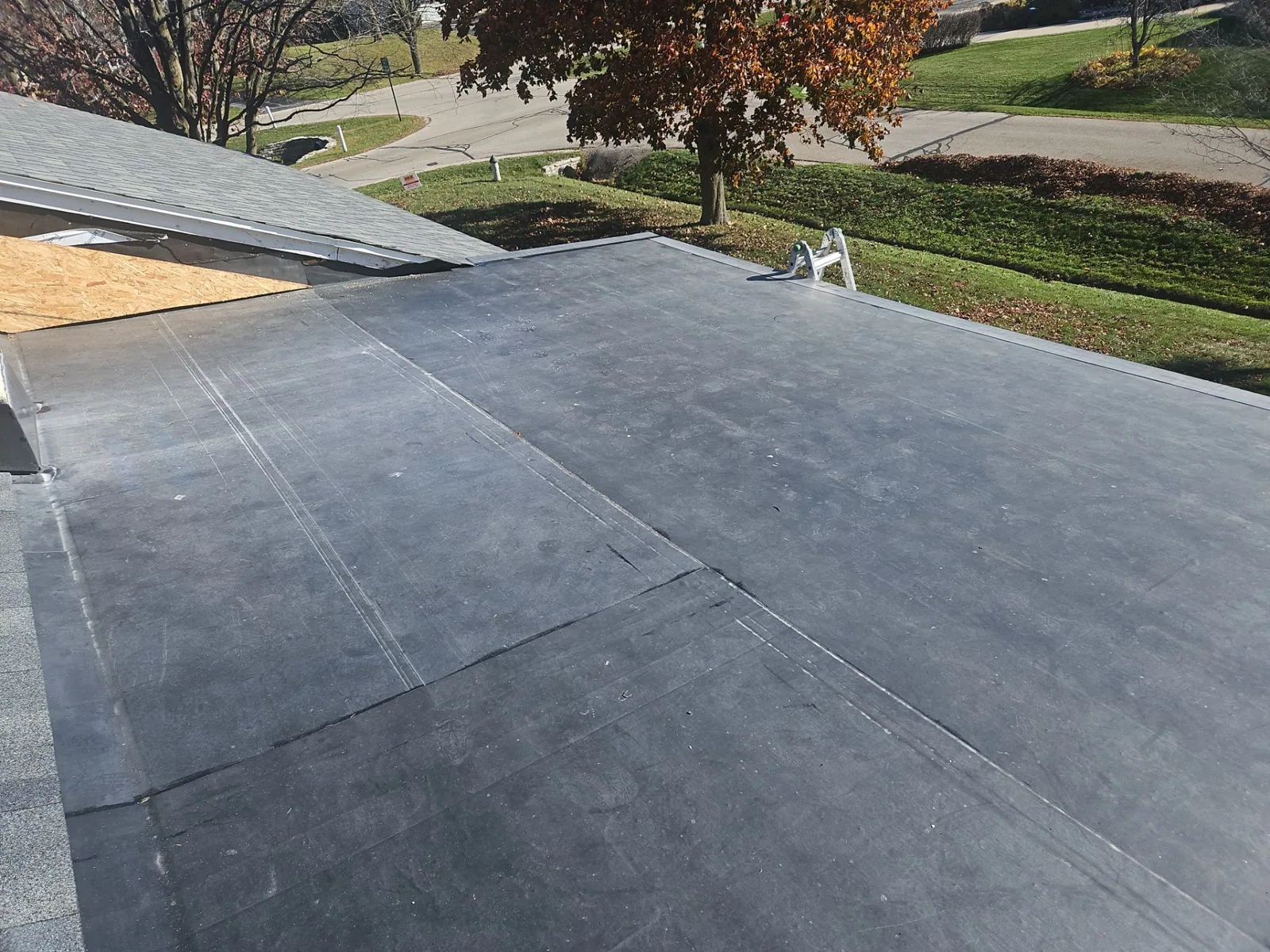
A Johns Manville roof is often a stack: membrane or built-up plies on top, a cover board, and thick insulation below, all sitting on a deck. A leak can start in any layer and show up far from where it entered. For a commercial owner in Springfield, MA, the repair question is rarely about the top surface alone. It is about how many layers are wet, how many are sound, and where the drain path actually runs. We read the whole assembly first, because the maker's name tells us what product family to expect but not what condition the layers are.
Read the assembly layer by layer
The maker supplies single-ply sheets, modified bitumen, built-up roofing and polyisocyanurate insulation, so a roof carrying its name may be any of those, or a combination from different decades. We take a core at a suspect area and a second one at a sound area for comparison. Each core shows the surfacing, the plies or sheet, the cover board, the insulation thickness and the deck. We photograph the stack and record the thickness of each layer, because the insulation depth also matters for drainage and for how a new layer must be tied in at walls.
Cores are patched the same day with a compatible material, and the openings are marked on the roof plan so no one has to find them again later.
Access to the roof surface comes before any of this. We note the ladder or hatch location, the roof edge protection needed, the safe route around skylights and the point where a lift can reach. A roof with a long approach or limited tie-off points takes longer to survey, and that time belongs in the schedule.
Built-up plies and their failure points
A built-up roof fails at the edges, the flashings and the places where the top surfacing has worn away. Blisters can hold trapped moisture, and splits in the felts let water run along between plies. We check whether the surface gravel or coating still protects the top ply, and whether the flashings were turned up and sealed. A blister alone does not prove wet insulation below it. The moisture scan does, and it tells us how far the removal needs to go before a repair can hold.
Where a built-up roof has been recovered with a newer sheet, the older plies below may still hold water, which is why the core matters more than the surface.
Repairs to felts follow the same rule as any other bitumen work: the substrate must be dry, the old surface must be cleaned, and new plies must lap over sound material. A patch that covers a split but leaves the wet felts under it will blister again, and the owner pays twice. We mark the cut limit in paint on the roof so the removal boundary can be checked at any time.
Insulation, cover board and drain slope
Polyiso insulation loses value when it is wet, and it can crush at foot-traffic areas near equipment. We probe soft spots and compare the readings with the moisture scan. When insulation is replaced, the cover board choice affects how well the new sheet resists punctures and how smooth the surface remains. Tapered boards can also fix ponding water by restoring a path to the drain. A flat patch over a low spot only hides the pond for a season.
Each added inch of insulation raises the roof edge, which changes the height of every curb and parapet flashing. We measure those heights before the quote, since a new layer that leaves a curb too low must be paid for in extra work later.
If a roof drains toward interior drains that were set when the building was new, the insulation slope may have settled around them. A tapered package tuned to the actual low points costs less over time than repeated patching at the same pond.
Industrial roofs in Chicopee and East Springfield
The Westover Metropolitan Development Corporation reports four industrial parks in Chicopee, and neighboring Springfield has its own industrial land in East Springfield, where the city's Smith & Wesson site fronts Roosevelt Avenue and is visible from I-291. On an industrial low-slope roof, drains can sit far apart and the roof can carry rooftop units, vents and conduit runs. We walk the drain paths, clear strainers and check each curb and penetration. Snow load matters too: Westover Air Reserve Base logged 20 inches in the February 2013 storm.
Work on a roof of this type is divided into roof sections so the building keeps operating. Each section is dried in before the crew leaves it.
Repair, recover or tear off
If the moisture is local, we remove and replace the affected insulation and plies and tie the new work into the sound roof. If the assembly is dry but worn, a recover overlay may add life, subject to deck condition and code. If the insulation is wet across several roof sections, we tear off to the deck and rebuild. Plan review comes before any recover or tear-off, since the Building Division applies the 780 CMR 10th Edition to Springfield alterations.
The cost follows the amount of wet material and the number of tie-ins, so a clear moisture map lets the owner compare options on equal terms.
Phasing is part of the decision. A tear-off in thaw weather can leave an open deck for a day, so each roof section is stripped, insulated and covered within the same weather window, and temporary protection stays on the next section until the crew returns.
What goes in the turnover file
The file lists the layers found, the thickness of each, the repair limits, the photographs and the trigger for the next inspection. A good roof condition report lets a new facilities manager see the history without calling anyone. When the same building has a Holcim Elevate section on one wing and a Johns Manville section on another, the file marks where one system ends and the other begins.
Tie-ins to adjacent work, such as a section covered with Sika Sarnafil sheet, are drawn on the plan with their dates, so the next contractor knows where two systems meet.
Commercial Roofing Questions
Does a Johns Manville roof always have JM insulation?
No. Roofs get re-insulated and patched over the years, so layers can come from different makers. A core shows what is actually there. We note each layer in the report so later repairs use compatible material, and so the owner has one record of the whole stack.
How do I know if the insulation is wet?
A moisture scan marks suspect areas, and a core confirms them. Stains inside the building only show where water arrived. The scan and the core together show how far the wet material extends across the roof, which sets the cost of the repair.
Can only part of a built-up roof be replaced?
Yes, if the rest is dry and sound. The new section ties into the old with a defined seam and flashing. We mark the boundary on the plan and list it as the tie-in for future inspections, so it gets checked each year.
Is tapered insulation worth adding at a reroof?
Where ponding is present, yes. It restores a drain path and reduces standing water. We check the drain count and the curb heights first so the added thickness does not create new problems at walls and equipment.
What does an inspection need from me?
The roof area, the leak pattern, access limits, any plans and the schedule you need. Even a rough sketch of the building helps us plan the core locations and the order of the walk.