The paperwork on a Springfield, MA roof may say Firestone, while the manufacturer now operates as Holcim Elevate. Both names point to the same family of commercial membranes, and an owner who holds old drawings, a warranty letter or a purchase order often has the earlier name on every page. That naming gap slows repairs, because a roofer who searches for the wrong label cannot confirm the system. We start by matching the paper to the roof, then testing what the roof is actually made of. The label helps with product research. The cut sample and the seam probe decide the repair.
Match the old paper to the roof
Submittals, closeout binders and warranty letters may use the earlier company name, a product line name or only an installer's job number. We list each document, note the date, and compare the stated membrane type with what the roof shows. Maker systems of this kind include UltraPly thermoplastic sheet and RubberGard EPDM. If the paper and the cut disagree, which happens after additions and partial replacements, we trust the cut and record the difference. The mismatch itself is useful, because it often marks where a later repair or an unrecorded section begins.
An owner who cannot find any paper is not blocked. The field evidence is enough to write a repair scope, and it can be photographed into a new record.
Where the building changed hands, the earlier owner may have kept the roofing file. A short call to the previous property manager sometimes turns up a roof plan or a repair log, and we ask the current manager to try that before we assume the record is lost. Each document found is scanned into the new file, with the date it was received.
Test seams for the family found
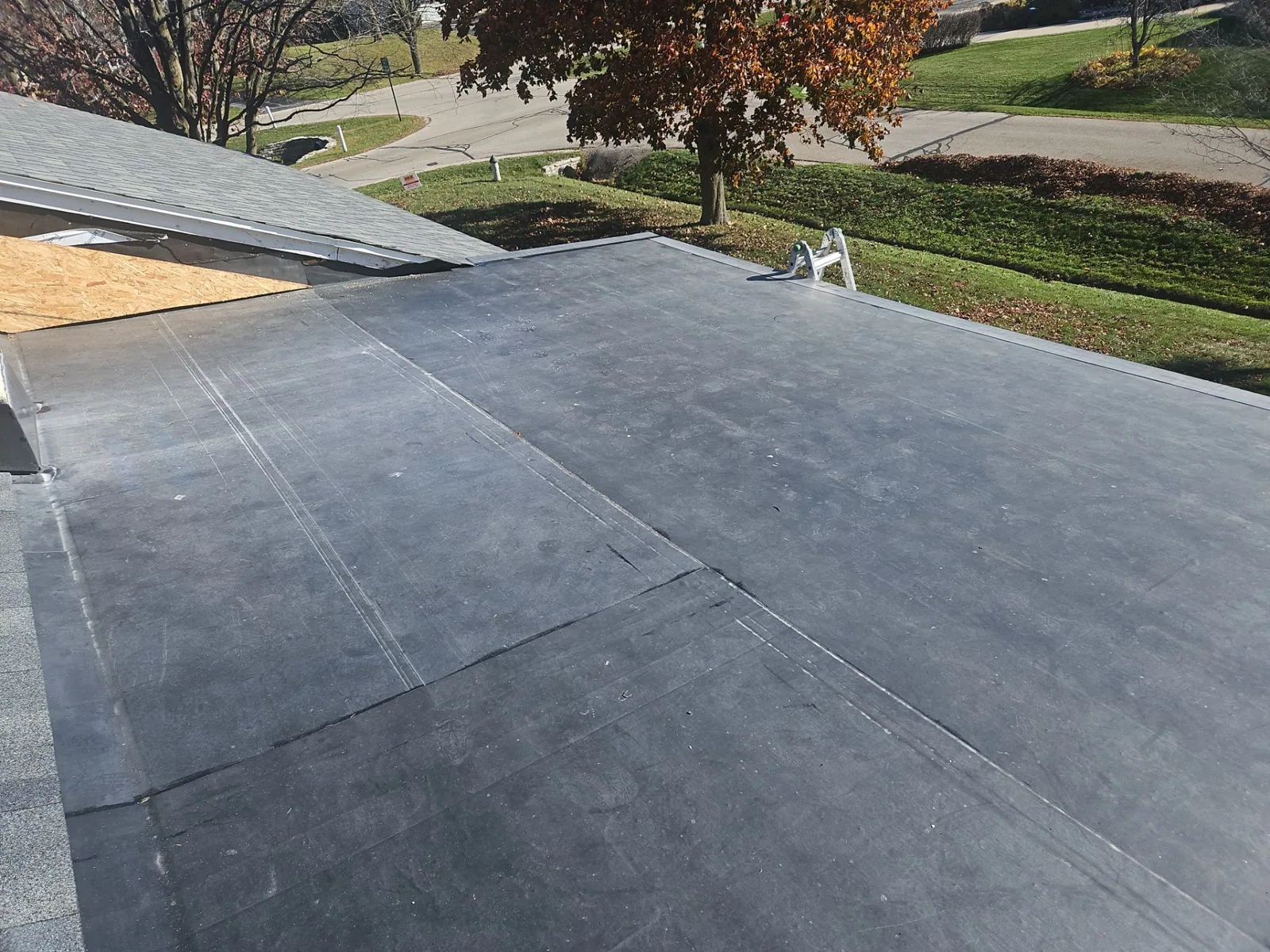
On a thermoplastic sheet we probe each welded lap and look for edges that lift or welds that skipped. On rubber, we check the splice tape, the lap sealant and the seam edges for creep. Either way, the corners and penetrations get extra time. A seam failure found at one corner often points to a pattern across the roof section, so we walk the whole section before marking the repair. When the failures are scattered and the sheet is still flexible, repair holds. When the sheet has become brittle, new patches only move the stress to the next lap.
Age is the other variable. A sheet that has weathered for many seasons loses plasticizer or flexibility, depending on the family, and it stops accepting a weld or a bond the way a younger one does. We test a small area with the repair method before committing to a full run, and we record whether the test held. That small trial prevents a day of repair work from failing at the first freeze.
Penetrations and skylights
Most leaks on membrane roofs begin at a detail, not in the field of the sheet. Pipe boots crack, curbs settle, and the flashing around skylights and penetrations loses its bond. We inspect each detail, test the sealant, and mark the ones that need rebuilding. Rebuilt flashings use compatible materials and are lapped over sound membrane. If a curb is too low for a new layer, we raise it before any recover goes down. Skipping that step leaves a leak at a point where the new roof was meant to be better than the old.
Drains deserve the same scrutiny. A leak that appears after rain may trace to a clogged strainer that sent water over a curb, not to a failed sheet. We clear the drain, run water if access allows, and confirm the path before we blame the membrane.
Downtown storefront roofs
Springfield's 2021 Northeast Downtown plan studies the street grid around Liberty, State and Harrison Streets and calls out older downtown infrastructure as a constraint on redevelopment. Along the Northeast Downtown district and Chestnut Street, storefront buildings sit side by side, so one roof walk can cross several assemblies. Access is often through the building or from the street, and storefront activity below sets the hours. We schedule noisy work early or late and keep walkways under the work protected.
The plan also names vacant or underused parcels among the redevelopment constraints. On a storefront building, we note shared walls and places where a lower roof meets a higher wall, since runoff from the higher roof lands on the lower one and tests its flashing.
Eastern neighborhoods and winter exposure
On the city's eastern edge, Boston Road begins roughly five miles from Metro Center and runs beside the Wilbraham line, and its roofs see the same freeze and thaw as the rest of the city. The state's 2023 ResilientMass plan puts snow and ice weight on roofs among the harms from severe winter storms. Drain paths and perimeter flashings get checked before the first heavy freeze, and any ponding area is marked, since ice at a low spot works at a seam all winter.
Where a building carries rooftop equipment, units may need to be lifted off curbs during a recover and set back on raised supports. Coordinating the mechanical trade with the roof crew is part of the schedule, and we list the equipment moves in the work plan before the first day.
Closeout and next inspection
We close each job with a written record: the system found, the old name and new name matched, the repairs made, their limits, and photographs of every opening. If the roof carries a manufacturer warranty, the notice requirements are checked before work starts. A neighbor roof of Versico or Soprema material is noted in the same file when it shares a wall or a drain path. The next inspection is set after the first heavy freeze or after a major wind event.
An owner who holds several buildings gets one record format across all of them, which makes it easier to compare roofs and rank them for capital planning. The same record also supports a warranty file when a claim needs dates and photographs.
Commercial Roofing Questions
Is a Firestone roof the same as a Holcim Elevate roof?
The membranes come from the same product family under a newer company name. We identify the installed system by testing the roof, since the name on the paper does not tell us the condition of the sheet or the seams.
What if my warranty letter uses the older name?
Keep it and send it to us. We read the notice and repair terms as written, and we match them to the roof found. The older name does not stop a repair from being planned or permitted.
Can I repair UltraPly with any thermoplastic patch?
No. The patch must bond to the installed sheet and be cleaned and welded correctly. Mixed materials lift at the edge within a season. We confirm the sheet first and match the repair material to it.
How do I find out whether my roof is EPDM or thermoplastic?
Look at the seam. Tape or adhesive at the lap points to rubber. A smooth welded lap points to thermoplastic. A small test cut and a look at the backing settle any doubt before work starts.
What do you need to start?
The roof area, the leak pattern, the access limits, any warranty paper under either name and your target dates. A photograph of the nameplate or a stamped label on the roof is useful if one exists.