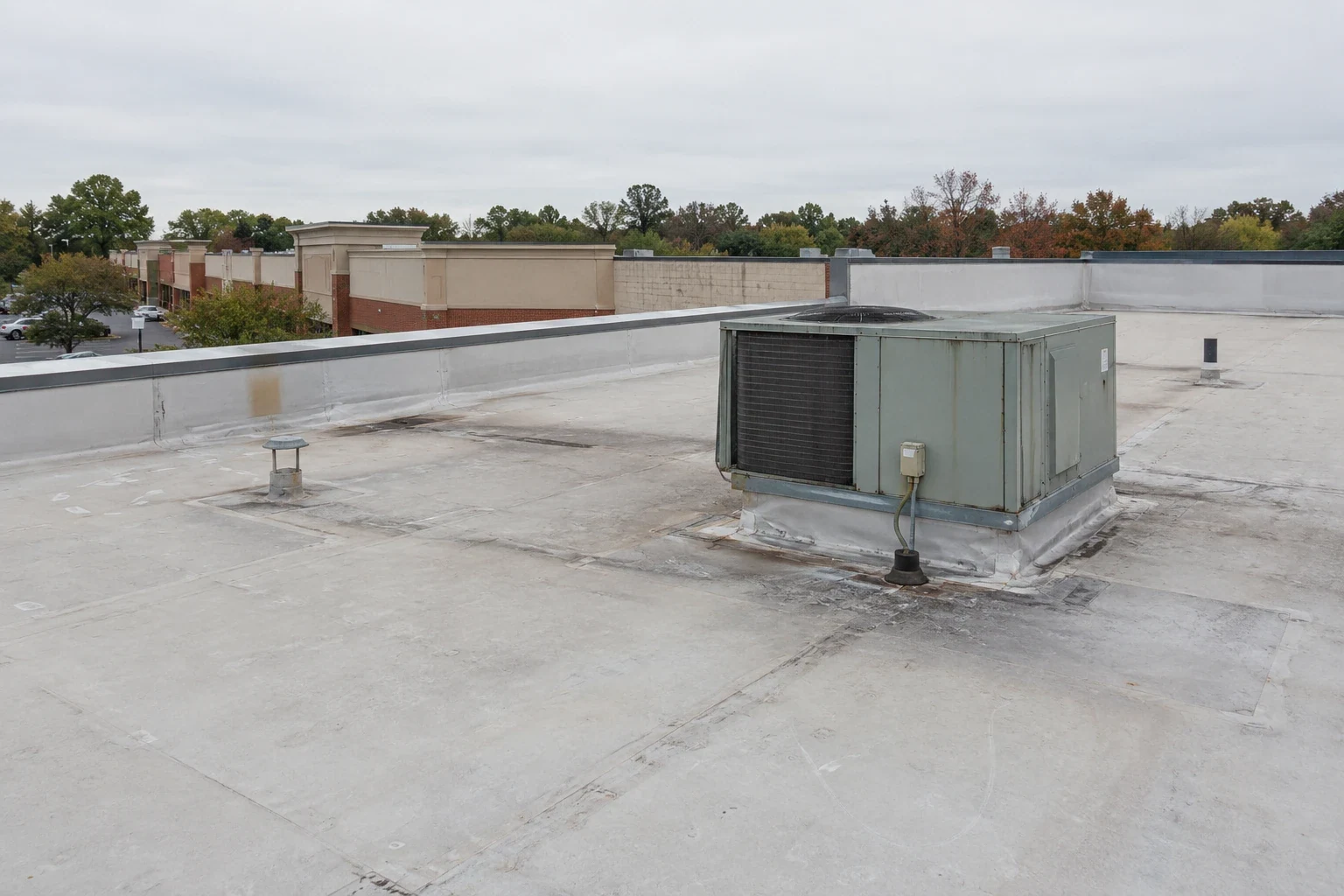
Dripping from a gym ceiling in January is not always a roof leak. Fitness centers, recreation centers and school gyms in Springfield, MA run warm and humid inside while the outside air sits below freezing, and moisture condenses on cold surfaces in the roof assembly. The same buildings also have long clear spans, big skylights and natatorium sections that stress a roof in ways an office does not. Springfield's neighborhood profiles list generous park land, such as the more than 100 acres of parks and open space in Indian Orchard and the 41 percent of Forest Park reported as conservation or park land. We start by working out whether the water came from above or formed inside.
Separate condensation from leaks before cutting anything
A roof leak follows rain or thaw. Condensation follows indoor humidity and outdoor cold. We compare the dates of the drips with weather records and with activity in the building. Drips on cold mornings after a busy evening class point to condensation. Drips that follow a storm point to the roof.
Then we test. We look at vapor retarders, insulation continuity and air leakage at the deck and the walls. We use moisture mapping to see whether the insulation is wet from a leak or from condensate. The answer decides the repair. A new membrane over a condensation problem fails just as the old one did, so the report shows the diagnosis before the scope.
Air leakage is the quiet cause. Gaps at the wall-to-deck joint, around penetrations and at the ceiling let humid air into the assembly even where a barrier exists. We use smoke or thermal checks where the interior can be reached and seal what we find.
Pool and natatorium sections need a vapor plan
A pool hall is a very humid room. Warm, moist air pushes up through the ceiling and into the roof assembly, where it meets cold layers and condenses. Over time that moisture corrodes fasteners, rots wood and soaks insulation. Metal decks and ceilings show rust streaks.
We check the vapor barrier, the ceiling plane, the ventilation and the roof insulation. If the assembly was built without a proper barrier, adding one may require opening the roof. A replacement scope for that section includes the barrier, insulation designed for the humid side and ventilation checked by the mechanical engineer. We do not cover a wet assembly with a new membrane.
Long spans and skylights collect snow and leaks
Gym roofs often have wide spans with few penetrations, plus skylights or clerestories for daylight. The state's hazard analysis calls severe winter storms a high-likelihood hazard and counts roof damage from snow and ice weight among what they do. Snow drifts against a taller gym wall and loads the lower roof beside it.
We inspect the roof near those steps, the drains and the skylight curbs. Skylight and penetration flashing is a frequent leak path: the curb moves, the gasket hardens and the flashing pulls away. Where a skylight has leaked more than once, we price a replacement unit with a new curb flashing next to repeated sealing. Ice guards protect people below.
Locker-room and shower exhaust terminates at the roof as well. Fans that discharge into the roof space instead of through it feed the condensation problem, and we trace each duct to its termination.
Keep members, classes and children away from the work zone
A fitness center has its peak hours at dawn, midday and evening. Recreation centers add children's programs, camps and league games. The work zone must be fenced and signed, and the hoist and debris route kept away from the entrance and the pick-up lane.
Noisy work over a studio or a court is scheduled around classes and games. We talk to the manager about the quietest days, and we avoid leaving a section open overnight. Dust and fumes stay out of the air handling by covering intakes near the work. In an occupied building reroofing, the front desk gets the schedule first so it can answer members' questions.
Parking and drop-off are part of the plan too. Contractors' trucks, hoists and fencing take lot space, so we agree on a staging footprint with the manager that leaves accessible spaces and the main drop-off clear.
Check high walls and edges against the tornado record
Weather Service surveyors tracked an EF3 tornado across Springfield on June 1, 2011, and found roofs removed from some large commercial brick structures. Gyms have tall walls and big roof areas, so edge securement matters. We check coping, edge metal and the membrane termination for secure attachment.
Loose items are fixed first. Tornado damage roof repair after a severe storm starts with temporary protection and a record of damage, and then moves to the permanent scope. The same records help with a claim.
Rooftop dehumidification and air-handling units, common on pool halls, are heavy and sit on large curbs. We check the curb flashing and the support under each, and we note any unit that has been replaced with a larger model, since added weight shows first as deflection and ponding.
Pick the assembly for the humid side
Membrane choice follows the diagnosis. A PVC roof resists many chemicals and welds at the seams, which suits buildings with chlorine or heavy exhaust. A TPO membrane may suit a dry gym. The insulation and cover board matter just as much, and the vapor control layer matters most in a humid building.
We compare complete assemblies and state what each includes for wet insulation removal and curbs. When the roof assembly changes, plans go to Springfield's Building Division for permit review. Owners with recreation buildings and schools, including a school roof with a gym wing, can plan both together.
Plan for the next inspection, not just this repair
Fitness operators and recreation departments plan around memberships and seasons. We give them a short inspection routine: after the last thaw, before the first freeze and after any major storm. Each visit checks drains, skylights and the edge, and photographs the results.
The record shows how the roof is aging and when to budget for the next section. Buildings in Indian Orchard or near Forest Park are measured on their own findings, and a church hall with a gym follows the same logic.
The same record helps with insurance and with budget requests to a board or a parks department, because it shows condition, age and cost in a form that non-specialists can read.
Commercial Roofing Questions
How can I tell condensation from a leak?
Leaks follow rain or thaw. Condensation follows indoor humidity and cold weather. We compare drip dates with weather records and with activity in the building, then test the insulation to see whether it is wet from above or from within.
Why do pool-hall roofs corrode?
Moist air rises into the roof assembly and condenses on cold layers. Without a vapor barrier and proper ventilation, fasteners and decks rust and insulation stays wet. We check the barrier, the ceiling plane and the ventilation.
Can a skylight be repaired instead of replaced?
If the curb is sound and the glazing seal is intact, a repair can hold. If the curb has moved or the unit has leaked repeatedly, replacement with new flashing is the better use of money, and we price both.
Can the gym stay open during a reroof?
Often, with sections closed daily and noisy work scheduled around classes and games. Some areas near the work may close for short periods, and the front desk gets the schedule before members do.
What membrane suits a humid building?
The diagnosis and the exposure decide. PVC suits chemical exposure and welds well. In a humid building the vapor control layer matters more than the membrane brand, so we specify it first.