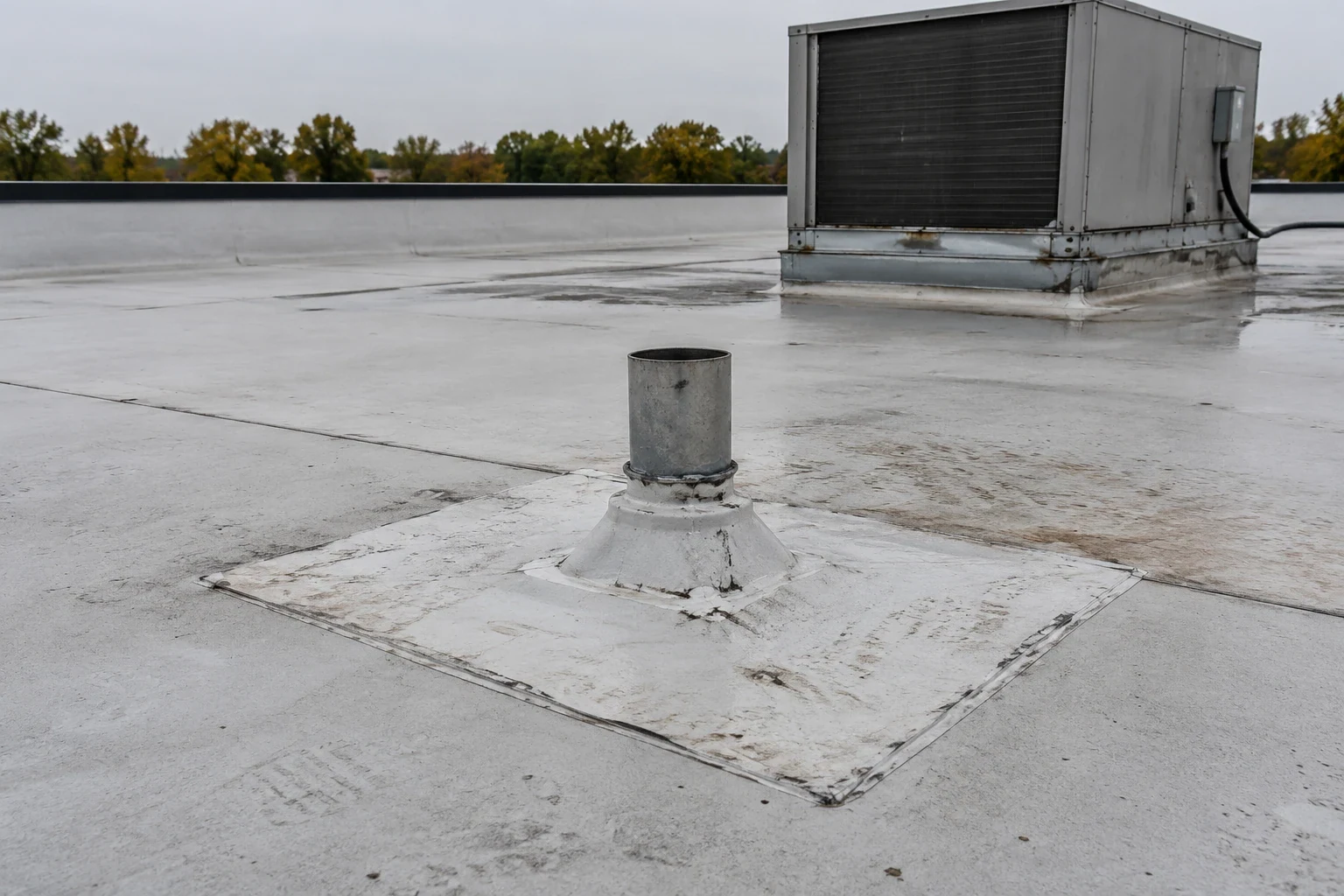
A wet wall line beside a roof does not tell us whether the opening is at the counterflashing, membrane termination, or a nearby curb. In Springfield, the 2011 tornado damaged large commercial brick structures and removed roofs from some buildings, a reminder to inspect transitions after severe wind. We trace the leak to the detail, check the material behind it, and mark where a repair can tie into sound work. A Medical District property may need the repair sequenced around an active interior, while a building along the State Street corridor may need a coordinated lift and delivery route. We keep those constraints with the roof notes so the repair is specific to the opening and the building’s use.
Follow the transition
Flashing changes direction, material, or plane. At a parapet, we examine the membrane turn-up, termination bar or counterflashing, coping, and the wall surface above. At an equipment curb, we check corners, pitch pans, sealant, and any point where service work may have disturbed the detail. A skylight or pipe penetration has its own geometry and movement. We photograph the condition before removing material and compare the stain timing with rain direction, roof slope, and the closest drainage path.
A leak may travel behind the wall finish or beneath the membrane before it becomes visible. We inspect adjacent seams and insulation, then open only enough area to establish the repair limit. A leak investigation can pair the interior report with roof findings; a seam review helps separate a lap opening from a wall transition. If the water path reaches a drain or scupper, we check that detail too rather than treating the wall as the only possible entry point.
Find why the flashing opened
Common causes include a failed sealant bead, loose termination, split membrane, corrosion, movement at a curb, or a patch that does not bond to the existing surface. We look for more than a visible gap. Rust streaks, displaced fasteners, dirt lines, and recurring wet insulation can show where water has been traveling. At metal-to-membrane transitions, the materials may expand at different rates, so the repair must preserve movement without leaving a channel for water.
Court Square sits within Springfield’s central business district. For a flashing repair near that grid, we confirm the lift approach and metal delivery with the property contact before the transition is opened. A phased occupied-building sequence keeps the roof work zone separate from active circulation while the flashing is opened.
When wind has lifted the edge or parapet metal, the underlying attachment deserves attention. A wind-damage check can document adjacent fasteners and membrane beyond the flashing. The June 1, 2011 Springfield EF3 event produced extensive south-side downtown damage after its path crossed the river at Memorial Avenue Bridge. We use that local history to guide an edge check, then set the scope from the roof condition in front of us.
Rebuild the detail
We remove loose or failed material until the substrate and adjoining roof are suitable for a tie-in. The replacement detail may use compatible membrane flashing, reinforced liquid-applied material, new metal, or a combination selected for the roof system. Corners and changes in plane receive shaped reinforcement; terminations are secured to a sound substrate and protected from water entry. Sealant alone is not a substitute for a properly formed flashing assembly.
The work boundary depends on how far the material has separated and whether moisture has reached the insulation or deck. If the membrane is sound beyond one curb, repair can remain local. If several transitions show the same movement or the assembly is wet across a larger section, we compare a broader scope. A cover-board assessment can help determine what remains suitable, while recover planning depends on the existing layers and attachment. We state what needs testing before setting a permanent price.
State Street carries business and institutional frontage across Springfield. For a building on that corridor, we confirm lift staging and the material route with the property contact before opening a transition.
Set the repair limits
A useful scope names the exact wall, curb, or penetration, the materials removed, the replacement detail, and the length of sound tie-in required. We record whether insulation was dry, damp, or removed and what evidence supports that finding. If deck attachment remains uncertain, the scope lists it as a test or change condition. Photos capture the detail before, during, and after repair, with the location marked on the roof plan.
Cost and schedule depend on access height, metal fabrication, substrate repairs, weather, and the amount of membrane that must be opened. A short parapet repair may fit within a narrow weather window; multiple curbs near active equipment can require trade coordination. We price the confirmed work separately from conditions that may appear after removal. Condition reporting gives the owner a record of what was found, while a roof inspection can check surrounding transitions before they become separate leak calls.
Verify before leaving
Before the crew closes the work area, we check the flashing’s attachment, corners, seal, and connection to the field membrane. We make sure water can pass toward the drain path and does not collect behind a raised edge. Removed material and loose debris are cleared from the roof. The site contact receives the repaired location, photographs, and any adjacent condition that remains open for a separate decision.
Springfield alterations may require permit review and inspection. We send the owner’s team the roof detail and repair boundary before mobilization. That review does not replace field verification of the completed transition. A later leak or movement at the same location should be compared with the closeout record, including any follow-up check we identified.
For an active leak, the response plan depends on safe access and current crew availability. The site can limit interior exposure while we confirm the next visit window. Share the roof access rules and the interior area affected so the first inspection can be planned around both.
Repair or extend the scope
If the flashing failure is isolated, a targeted repair can restore the transition without opening unrelated roof areas. If similar details are loose across several sections, we map them and compare a coordinated repair with replacement of a larger perimeter run. The roof system, attachment, and deck condition determine whether the existing membrane can accept the new detail. We do not extend the scope merely because one corner needs work.
Waiting can spread moisture into insulation and interior finishes, particularly where water follows the wall before appearing indoors. A prompt inspection can establish whether temporary protection is needed and which detail should be opened first. The records then support a repair, a test, or a broader project decision. Edge-metal work may be part of that scope where coping or fascia attachment is involved.
Commercial Roofing Questions
Can sealant alone stop flashing leaks?
Only when the existing assembly is sound and the sealant joint is the failed part. We inspect attachment, membrane turn-up, corners, and substrate before choosing a repair detail.
Why does water show up below a different roof area?
Water can move behind wall finishes, along insulation joints, or across a deck before reaching the ceiling. We compare the interior mark with the roof geometry and test the likely path.
Do you replace the whole parapet edge?
The boundary follows the condition. We check how far the flashing and attachment have failed, then extend the repair only far enough to reach a stable tie-in.
What happens if insulation is wet?
We mark the affected material and remove it to a suitable limit when the assembly needs to be opened. The report separates confirmed wet areas from sections that need testing.
Can a flashing repair be phased around building use?
Yes, where the access and weather window allow it. We coordinate the roof section, interior protection, and tenant routes with the facility contact before opening the transition.