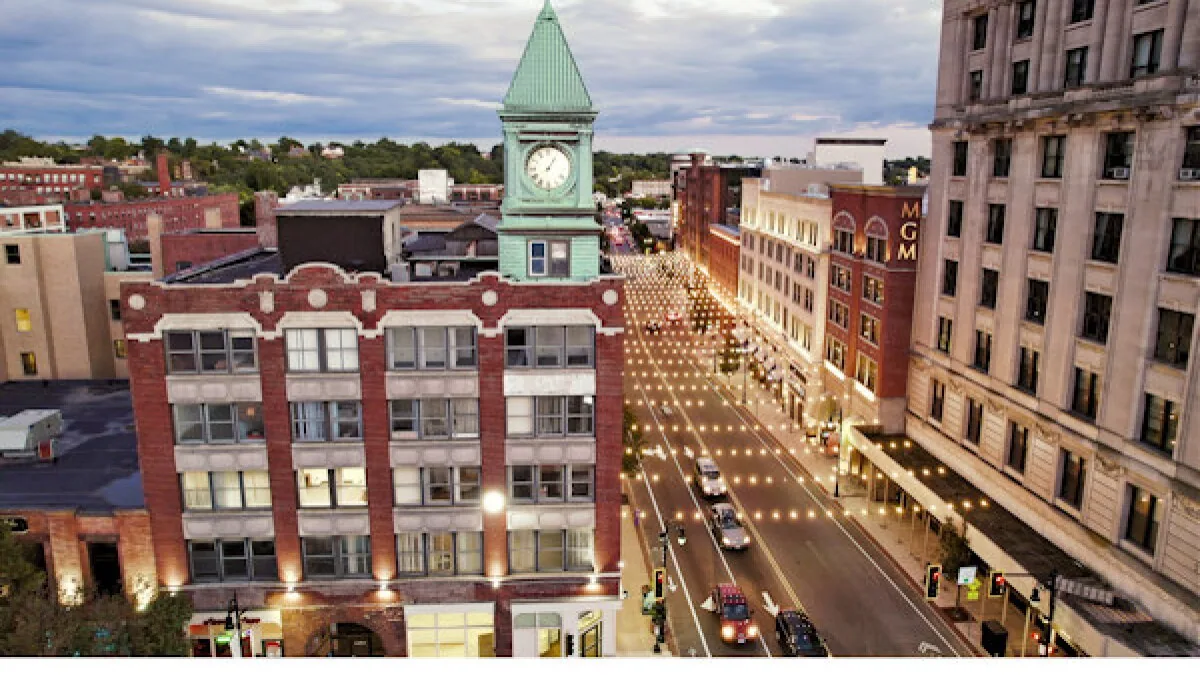
Redevelopment partners sign on to expectations, and a roof can quietly decide whether they meet them. The Springfield Redevelopment Authority lists Eastern Avenue as an urban renewal plan area dated May 1986, and it says renewal plans define the project area and state what is expected of redevelopment partners. For a developer, owner, or general contractor working in the Eastern Avenue District of Springfield, MA, the roof belongs in that conversation early. A building that is reused, expanded, or sold carries its roof along, and a documented roof condition is cheaper to produce before commitments are made than after.
The plan itself tells us the district is organized for partnership. A survey supplies what a plan does not: the system, layers, and condition of each roof, and it belongs ahead of the first major commitment.
Survey the roof before signing on
A roof survey before a purchase, a lease, or a redevelopment agreement turns an unknown into a known. We walk each roof, probe seams, check flashing and edges, and use infrared and test openings to find wet insulation. The report sorts findings into repairs now, work in the next few years, and long-range items.
That sorting feeds the budget and the schedule. A partner who knows a roof needs replacement within two seasons can plan around it. A partner who finds the roof sound can say so in a lender presentation. A due diligence roof survey is written to be read by someone who was not on the roof.
Cost drivers get named in the report so a partner can see what moves the number. Tear-off depth, the footprint of wet insulation, drainage changes, equipment disconnects, and access each appear as separate lines. When a partner asks why one roof costs more than another, the answer sits on the page.
Timing gets the same treatment. The report lists what must happen before winter, what can wait for spring, and what depends on permits or tenant dates. A partner reading it can see which items are fixed and which can move.
Use the city layers, then confirm on the roof
The city publishes renewal-area maps together with parcel, building-outline, zoning, and road layers. Those layers help plan a survey: which buildings, how large, which streets give access. Roof systems, layers, and moisture come from the roof itself.
We use the layers to build the walk list and the access plan, and then we confirm each roof in person. The register that results lists each building, each roof section, the system, the condition, and the open items. It becomes a working document for the partners, and it can be updated as the project moves.
Access is part of the register. For each building we note the roof hatch or ladder, the key holder, the hours, and any safety limit such as open edges or skylights without guards. A crew that arrives with that information starts working on the first visit instead of the third.
Photographs are filed by roof section and by finding, with captions that name the location. Anyone opening the file can walk straight to the item in question.
Build the file a partner can hand over
Handoffs are where records get lost. A roof file for a redevelopment project holds the survey report, photographs, repair history, warranty documents, and the scope of any work done. We organize it so a new owner or lender can find an answer in minutes.
Warranty papers matter most when something goes wrong. A repair that departs from the manufacturer’s method can void coverage, so the file lists the terms that apply to each section. Our roof warranty management practice keeps that match current as repairs and additions occur.
Insurance sits in the file too. Photographs taken before a storm give roof insurance claim assistance something to compare with afterward. After a storm, we compare the new walk with the record and sort damage from wear.
Lenders ask for roof condition at closing and again at refinance. The same report, updated, answers both requests without a new survey from scratch.
Reserve notes belong in the file as well. A roof that is sound now but has a limited life left gets a window and a list of findings that would move it.
Decide from the moisture, not the age
Age is a weak guide to roof decisions. Moisture, seam condition, and drainage tell more. Wet insulation in separate areas supports replacement of those sections.
A partner comparing bids can match them line by line because each scope names the same drivers.
Edge metal and flashing often drive the repair list on reused buildings. A coping run that has moved lets water into the wall, and a flashing cut by a past tenant leaves an open path. We fix those first, since they protect the work that follows. A commercial roof repair at the edge can prevent a field replacement from starting too early.
Where the walk finds dry, flat, well-attached layers, a roof recover may fit the budget and the schedule better than removal, and the report says what it would and would not fix.
Time roof work around winter
State hazard planning rates severe winter storms a high-likelihood hazard, so a roof closure date belongs beside every construction milestone. A roof open into November is a risk to everything below it.
We schedule tie-ins and edge work first, then field areas. If a delay pushes work into winter, the closed sections hold while the rest waits for a weather window.
Snow melts on a warm section, refreezes at the edge, and builds a dam that pushes water under roofing. We check eaves, soffits, and insulation near the edge, and we recommend air sealing and ventilation fixes where the pattern repeats.
Compare with other renewal areas
Partners with holdings in the Central Street District or the McKnight Renewal Area can place those roofs in one ranking, with one summary table for the whole group.
Partners rarely hold identical buildings, so the ranking measures what they share: wet insulation, seam condition, drainage, and the cost of a failure for the use below. Differences in age and system show up as findings, not as assumptions. Roof scopes in a partnership setting also name who approves a change in the field and by when, so an unexpected finding at a test opening goes to the right person the same day.
Commercial Roofing Questions
When should a roof survey happen in a redevelopment deal?
Before commitments, while there is still room to adjust price or scope. A survey during due diligence gives the partners facts to negotiate with, and the findings carry into the budget.
Do map layers tell you what a roof is made of?
No. Layers show parcels, outlines, zoning, and roads. Roof systems, layers, and moisture come from the roof walk and test openings.
What should a handover file include?
The survey report, photographs, repair history, warranty documents, scope of past work, and the turnover record. A new owner or lender should be able to find an answer in minutes.
Can a roof be repaired instead of replaced to keep a project on budget?
When the findings support it. A local failure over dry insulation is a repair candidate. If wet insulation or widespread seam failure appears, repair only postpones the cost, and the report says so.
How does winter affect a redevelopment schedule?
It sets a closure deadline. Tie-ins and edges are completed before freeze, and field work continues as weather allows. A building closed in time is protected even if the rest of the project slips.