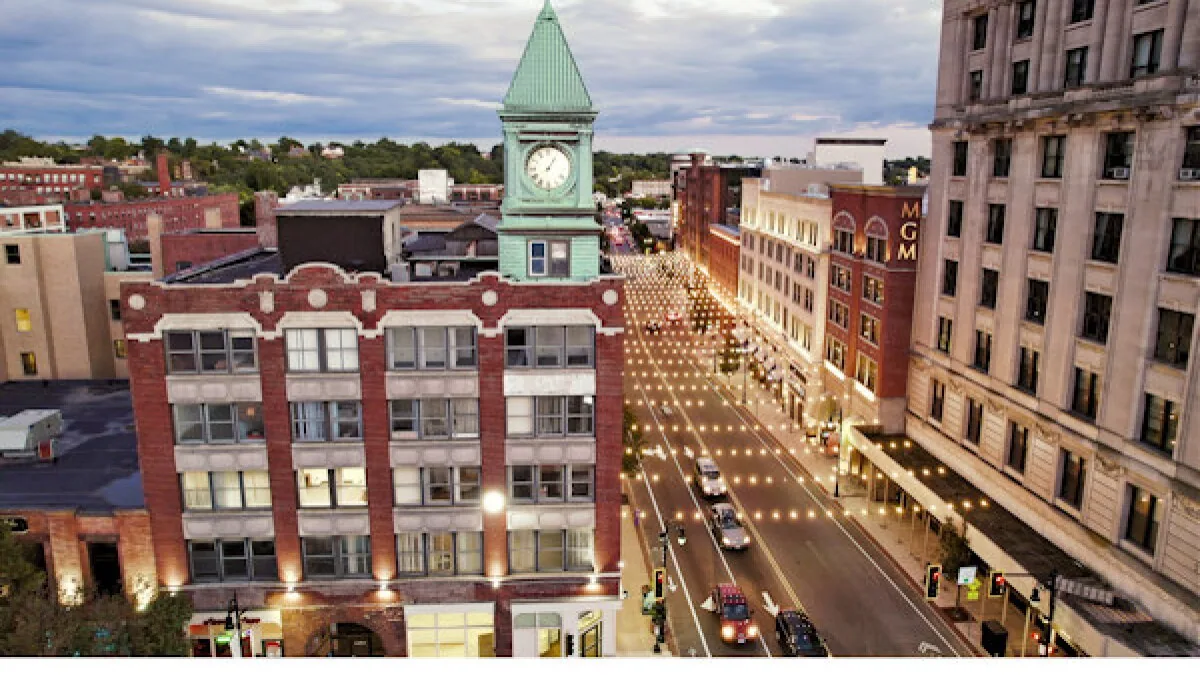
A roof in a historic district is rarely just a roof. It is a permit question, a drainage question and sometimes a question of what the wall below can take. McKnight lies about a mile east of Metro Center and covers 306.5 acres between Armory Street, Federal Street, the Boston and Albany rail line, the Highland Division rail line and St. James Avenue; the City's profile identifies it as a large local historic district and notes Rebecca Johnson Elementary within it. Low-slope and metal roofs on commercial and institutional buildings in Springfield, MA are what we repair, recover and replace, and in a district with a preservation interest the scope starts with what must be approved and what must be protected.
Who needs to approve the roof
Before pricing, an owner in a local historic district should find out whether the roof change needs review, which office handles it and how long it takes. The answer may depend on whether the work is visible from the street, whether it changes materials or color and whether it alters trim and edge details. Asking early avoids a stop-work problem after the permit is issued.
Plans and inspections go through the Building Division under the 780 CMR 10th Edition, and commercial energy requirements follow IECC 2021 with state amendments. We prepare drawings and product data that fit both reviews: roof plan, section details at edges and parapets, insulation values and product literature. A scope that answers a reviewer's usual questions moves faster.
Schedule risk lives in approvals. A review that takes weeks can push a summer project into fall, when cold surfaces limit what can be installed. We build the review time into the schedule from the start, and we tell the owner which decisions cannot wait, such as selecting a membrane color or edge metal profile. A decision made in February is much cheaper than one made in June.
Built-in gutters, scuppers and leaders
Where a building drains through built-in gutters, interior leaders or scuppers through parapet walls, those parts are among the most failure-prone on the roof. A built-in gutter that leaks does so into the wall, and the damage appears inside, far below the roof edge.
On the walk, we check gutter liners, seams, outlet connections and the condition of leaders where they are visible. We also look at where each leader discharges, since a downspout that dumps against a foundation sends water back into the building. Gutter repair or relining is often priced with the roof, because the same flashing connects the two.
Interior leaders deserve a separate look. They run inside walls or chases, and a crack or loose joint leaks without showing on the roof. A water test or a camera pass can find the failure, and the repair may involve opening a chase. We tell the owner what that costs before the roof contract is signed, so the interior work is a decision and not a surprise.
The walk in order
We walk a roof in a fixed order so nothing is skipped. Drains and gutters come first, because a roof that drains well forgives small flaws. Next is the perimeter: coping, edge metal, parapet caps, base flashing and counterflashing. Then the field, one roof section at a time, noting seams, blisters, splits and low spots. Penetrations and equipment close the walk.
- Gutter liners, outlets and leader connections
- Coping joints, mortar and cap flashing
- Membrane seams, laps and surface wear
- Curb detail and pipe flashing
- Soft areas that suggest wet insulation
Each finding is photographed and marked on the roof sketch. Core samples follow where the build-up is unknown, so the proposal rests on what the roof actually contains.
Freeze and thaw on older edges
In the 2023 ResilientMass analysis, severe winter storms are a high-likelihood hazard for Massachusetts, and snow and ice weight on roofs and structures is named as one of the damages. At the edges of an older roof, freeze and thaw does its work on gutters, copings and mortar joints. Water enters a crack, freezes, expands and widens it. Over a few winters, a hairline gap becomes a path for water.
We look for cracked coping, open joints, loose cap flashing and stains below the edge. A repair made in fall, with sealant or new flashing, keeps winter from widening the defect. Where the gutter itself is failing, replacement before the first hard freeze is cheaper than repairing the wall after it.
Brick, parapets and wind
The June 1, 2011 EF3 tornado that crossed Springfield, as the National Weather Service recorded it, damaged large commercial brick structures and took roofs off some. For owners of masonry buildings, the lesson is practical: the roof edge and the parapet carry the most wind-related risk. We check parapet cap condition, mortar joints and the connection between the roof edge and the wall, and we recommend repair of any loose element.
Equipment on a masonry roof needs the same scrutiny. Curbs fastened to the deck, units strapped to curbs and conduit supported on pads instead of laid on the membrane all reduce damage in wind and from foot traffic. A short fix list from the walk, with photographs, gives the owner a clear punch list.
Repair, recover or replace
For a roof with located defects and dry insulation, a repair is the fix. For a dry roof that can carry another layer, a recover avoids the tear-off. For wet insulation, multiple layers or a damaged deck, a replacement is the answer. Area, tear-off, deck repair, edge and parapet work, penetrations and access drive the price.
On older buildings, concealed conditions are common, so deck repair is priced as a unit rate and quantities are confirmed once the roof is open. The written options say what each path includes and when the next decision would come.
Keeping the building in use
Most buildings stay occupied through a roof project. We agree on the access route, staging, noise windows and daily closeout beforehand, divide the roof into sections and close each before the crew leaves. With a school nearby, we avoid arrival and dismissal times for deliveries and lifts. The property manager receives a short update each day, and owners with buildings in Old Hill or Bay can use the same format. A maintenance visit each fall checks gutters and drains before the freeze.
Protection matters most for interiors with finishes that cannot take water. We identify those rooms during the walk, place temporary protection before tear-off and dry in each section the same day. Moisture readings at closeout confirm that the new membrane did not trap water. The turnover record includes those readings, the product data and photographs of each stage, so the next owner or manager inherits a complete file.
Commercial Roofing Questions
Does a roof change in a historic district need review?
It can, depending on visibility and materials. Ask the City early, before the scope is final, and we will prepare drawings that suit the review.
How can I tell whether a built-in gutter is leaking?
Look for stains on the wall below the roof edge, damp plaster inside and ice staining at the gutter line. We then test the liner and outlets.
What happens when the deck is worse than expected?
We replace the damaged sections and bill them at the unit rate in the scope, with quantities confirmed when the roof is open.
Can I phase work to match the budget?
Yes, by roof section. The worst-condition area goes first, with temporary tie-ins flashed to hold until the next phase.
Should I fix edges before winter?
Yes. Sealing cracks and loose flashing in fall prevents freeze and thaw from widening them.