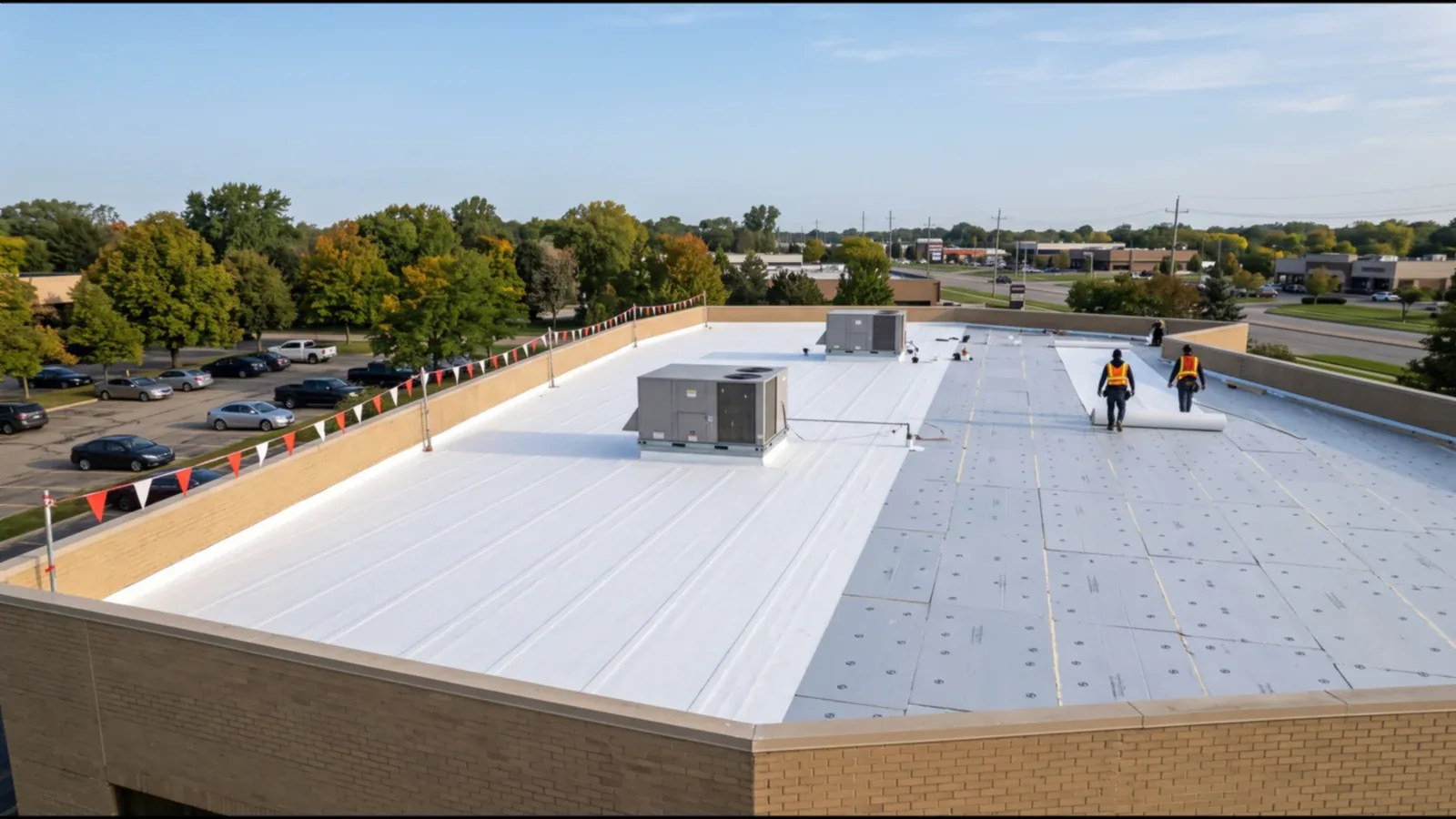
Rust streaks running down from a screw head tell us more about an exposed-fastener metal roof than a stained ceiling does. On Springfield, MA warehouses, shops and light industrial buildings, the panels are often screwed through the flat with rubber washers, and those washers dry out, split or lose their seat after years of freeze and thaw. The panels themselves may still be sound. A retrofit is the work of deciding what to keep, what to replace and what to cover: re-screwing, resealing, coating, installing a new panel system over the old one, or tearing off. We start by reading the fasteners, the laps and the structure underneath. The findings go onto one marked plan that the owner and the general contractor can both use, with each defect counted, photographed and tied to a panel line.
Read the fasteners and laps
On an exposed-fastener roof, most leaks start at a screw or a lap. We walk the panels, press each fastener head, look for rust, backed-out screws, stripped holes and cracked washers, and we mark lap joints where sealant has failed. A screw that has backed out can often be replaced with a larger one, but a hole that is stripped or corroded may call for a new panel.
We also check how the panels were fastened to the purlins. Wrong fastener type, missed purlins and over-driven screws are installation defects that become leaks over time. We record the count and location of each defect on the plan, so the owner can see the density of the problem and the repair crew can plan labor.
Sealant is the third check. Butyl tape and sealant at end laps, ridge caps and penetrations dry out and shrink, and their failure is easy to miss from above. We lift a few sections of trim to see the tape underneath and photograph its condition. If the tape is hard or missing, we replace it along the full run, since resealing one lap leaves the next one to fail.
Check the structure and what sits under the metal
A retrofit adds weight or changes attachment, so the structure must be confirmed first. We look at purlin condition, spacing and rust, check for sagging and review any engineering records. Where the structure is in doubt, we involve an engineer before pricing a cover system.
Condensation is another question. Metal roofs without a proper vapor path can drip from the underside, and the drip can look like a leak. We look for rust on the panel underside, wet insulation blankets and stains along purlins. If moisture is present, adding a cover system without fixing the source locks it in. The state's commercial energy code also affects insulation choices in a retrofit, so we check requirements early. A retrofit that adds insulation or changes the roof assembly goes through the city's plan review, so the permit set includes the layers, the fasteners and the energy compliance path.
Weigh the retrofit paths
The least invasive path is to re-screw, replace washers and reseal laps. That can extend the life of a roof with sound panels. A coating system, including silicone roof coatings, can seal fasteners and seams after cleaning and primer testing, but it does not fix loose attachments. A metal-over-metal retrofit installs a new framing system and panels above the old roof, which can add insulation and a longer life but requires a structural check and careful edge detailing.
Tear-off is the most expensive path and is chosen when the panels are corroded, the structure is compromised or the insulation is wet. A standing seam metal roof is a common replacement when the owner wants fewer exposed fasteners and a roof designed for movement. We price the paths side by side so the owner sees first cost, expected maintenance and what each one asks of the building. A cheaper path that needs repair every spring is not cheaper over five years, and the comparison should show.
Plan for wind, snow and ice
An EF3 tornado in June 2011 removed roofs from some large commercial brick structures in Springfield, the Weather Service reported. Exposed-fastener metal roofs rely on fastener pull-out strength, so edge zones and corners need closer spacing and sound purlins. Snow and ice load is a recognized cause of roof damage in severe Massachusetts storms, so snow loads and retention matter on any new system added above old.
In places such as the Boston Road commercial area in eastern Springfield, which the city places beside the Wilbraham boundary and the North Branch of the Mill River, an owner with a metal building checks the same things after any storm: edges, ridge caps and gable trim first, then fasteners along the roof field, and only then the interior leak. A leak repair that skips those checks tends to return.
Wind damage on a screwed-down roof shows as lifted panel edges, torn holes around fasteners and bent trim. We photograph each, mark it on the plan and trace the lift to the first sound line of fasteners. Where the edge has lifted, the next panel is at risk, and we repair or replace the whole run instead of a patch at the visible damage.
Sequence the work and keep the record
A retrofit often happens while the building operates. We plan the work in bays, stage panels at the edge, cover open areas by the end of the day and keep forklifts and trucks out of the drop zone. For buildings in the Wason/North Industrial Park area, where industrial parcels share the North End geography, delivery windows and shift schedules shape the daily plan. We agree on forklift routes, where panels are staged and who clears the drop zone, and we keep the loading dock open if the building ships during the work.
The turnover record lists fastener type and spacing, panel gauge, new components, sealant types, the sequence of bays and photos of each one before and after. It also names the next inspection trigger. For units on the roof, we confirm that equipment curbs and supports are flashed to the new surface and not left on the old one.
Commercial Roofing Questions
Can I just replace the screws on my metal roof?
Often, if the panels are sound and the holes are not stripped. We use larger or different fasteners and new washers, and we reseal laps. A roof with many corroded holes may need panel replacement.
What is a metal-over-metal retrofit?
A new framing system and panels installed above the old metal roof. It can add insulation and extend life, but it needs a structural check and careful edge detail.
Will a coating stop leaks at screws?
It can seal them if the screws are tight and the surface is clean. A coating does not tighten loose fasteners or replace failed washers, so we tighten or replace first and coat second, and we test adhesion on a small area before pricing the full roof.
How can I tell condensation from a leak?
Condensation tends to appear in cold weather on the underside and drip along purlins. A leak follows rain. We check both and inspect the insulation.
Do I need an engineer for a retrofit?
If the structure is in doubt or the retrofit adds load, yes. We identify when an engineer is needed and prepare the roof information for them: purlin spacing and condition, panel gauge, existing loads and the proposed build-up, so their review is quick and the schedule does not stall.